


August 22, 2025
How Can We Furnish a Better Future?
When considering all the ways we could be designing better buildings— especially commercial buildings like office towers or education spaces— there’s one lever that people still don’t pay enough attention to: furniture.
The numbers are striking— about 8 million tons of office furniture ends up in U.S. landfills every year. And for a standard office renovation, furniture and furnishings account for about half of the space’s carbon footprint. So yes, furniture can help prevent harm in the world. It can help us make better buildings. But here’s the exciting piece, furniture can also be a tool for doing a whole lot of good.
We touch and interact with furniture every day. Well-designed furniture can make a big difference to our health and well-being. It also takes skill and craft to produce, which means furniture can uplift and empower communities and involve them in finding solutions for people and the planet. Using healthy, beautiful materials in furniture and furnishings can have a multiplier effect for our buildings.
In the latest episode of Deep Green, created in partnership with Allsteel and recorded live from NeoCon 2025, host Avi Rajagopal sits down with two guests who’ve been helping organizations make real impact through their furniture and architectural product selections: Lisa Brunie-McDermott, Director of Corporate Social Responsibility at HNI Corp. and Madison Gentry, Architectural Product Sales Enablement Manager at Allsteel.
They discuss how using healthy, beautiful materials in furniture and furnishings can have a multiplier effect on our buildings. Read an excerpt from their conversation below or listen to the full episode on the Surround Podcast Network.
The Sustainability Journey to Better Furniture
Avinash Rajagopal: Lisa, can you give us an overview of the sustainability journey at HNI and at Allsteel in particular?
Lisa Brunie-McDermott: I’m proud of the way that we focus on sustainability. We talk about it in three pillars—respecting people, reducing impact, and redefining tomorrow.
Respecting People: We’re really thinking about our members, our employees working in the manufacturing facilities, the communities in which we operate, and our supply chain partners.
Reducing Impact: We have 29 manufacturing facilities throughout the United States, so we have a lot of square footage, a lot of operational impact. We have opportunities to hit our goals around reducing carbon, reducing waste, getting to zero waste to landfill at all manufacturing facilities, reducing scope 1, 2, and 3 emissions, and purchasing 100 percent renewable energy.
Redefining tomorrow: This is how we think about creating more sustainable products. We’ve been focusing on packaging material, the chemical ingredients that go into our products, and lifecycle analysis. We’re trying to hit all those factors and move everything forward in all aspects of our operations and in all our departments—from product design to supply chain to on the manufacturing floor. It’s been a great journey. The tagline I use to sum it up is Better Choices Today for a Better Tomorrow. It is about that incremental change and making that positive impact over time. I’ve seen us grow over the last five years in tremendous ways.
AR: Absolutely. I love the tagline, Better Choices Today for a Better Tomorrow, because in it is also this understanding that if Allsteel makes better choices, it enables your clients, who are building and renovating offices, to make better choices themselves—and that can mean better impact for their organizations, for their stakeholders.
Amplifying Organizational Impact
AR: Speaking about impact with organizations, Madison, can you share that great example about the work you did with a client around drywall?
Madison Gentry: We have known for a long time that the benefits to using an architectural product solution, or otherwise known as a demountable walls solution, are there. We knew that the sustainability benefits were there, but we had never quantified it. So, we went through this lifecycle assessment where we compared conventional construction versus demountable construction, and quantified the results, not only in carbon emissions, but deferral of landfill waste.
When we got the results, the team was blown away. We expected that the results would be good because as the product is reconfiguring we’re not tearing down drywall and re-putting it up. We’re just moving the product around. But what we found is that through the work that Lisa’s team has done in terms of our operations and supply chain, but also inherently within the product, we had a 56 percent reduction of carbon emissions at the time of install, which goes to show that the product is more sustainable just inherently. You don’t have to move it around to make it sustainable. You don’t have to reuse it to make it sustainable.
56 percent is the equivalent to just over 104,000 miles driven by a gasoline-powered vehicle, or the equivalent to driving around the world four times. And that’s just carbon emissions at the time of install.
Can you imagine if we’re moving the product around? I’m really proud of those results because now that we have them and we’ve made it digestible and understandable, we can empower our clients with that information. It’s a new way of thinking when using architectural products, but we’re here and we can help you through it.
AR: Yeah, absolutely! I love that, because you start with a baseline responsible product, and then if people use it in responsible ways, in flexible ways, you can multiply that impact. That gap, that chasm between a demountable wall and a drywall is going to continue to widen over the life of that product. That’s incredible!
Communicating Through Data
AR: Lisa, tell me about how you communicate this kind of impact for your clients?
LB: I think it’s about having those conversations early in the process, especially with architectural products. How do we have it before they’ve selected the materials? Who is the person to have it with? Is it the GC? Is it the designer? I think that’s where it gets a little tricky.
But I do think now we have some data to really pinpoint the fact that this is beneficial. If you’re concerned about carbon, here’s a better choice that you can make.
One of the things we’re working on with a client is they want to see a reuse calculator for architectural products. So, we’re building a carbon calculator for them to use. They take a product, they put it in inventory, and then they take it out of inventory. They’re doing this swap all the time. Through this calculator, we’re giving them the capability to see how much carbon they save by reusing our product.
AR: That’s incredible! A: Make an impact with clients because of the product & B: Build tools to help them understand that impact better. But sometimes it’s also the project or the client that pushes you forward.
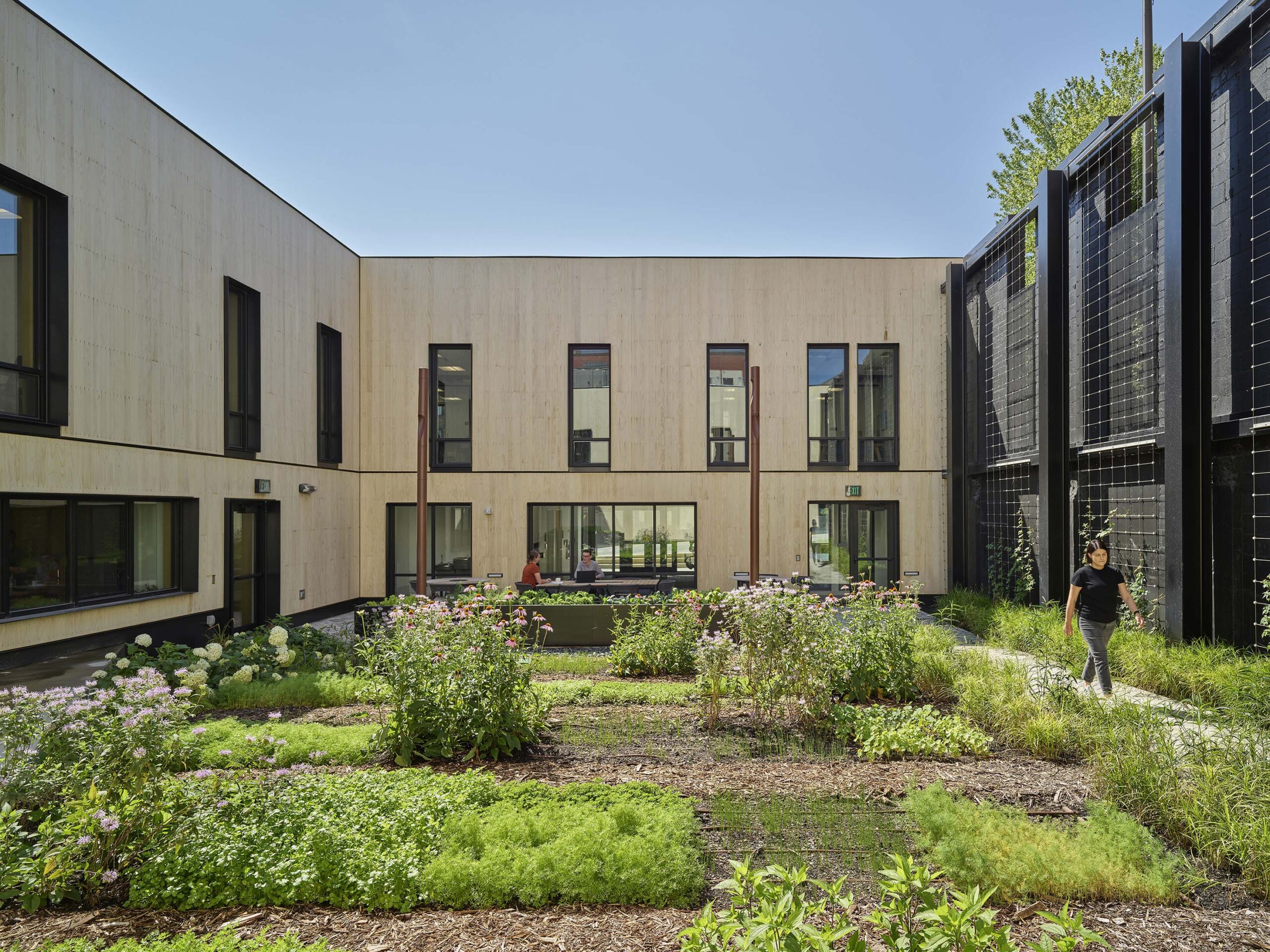
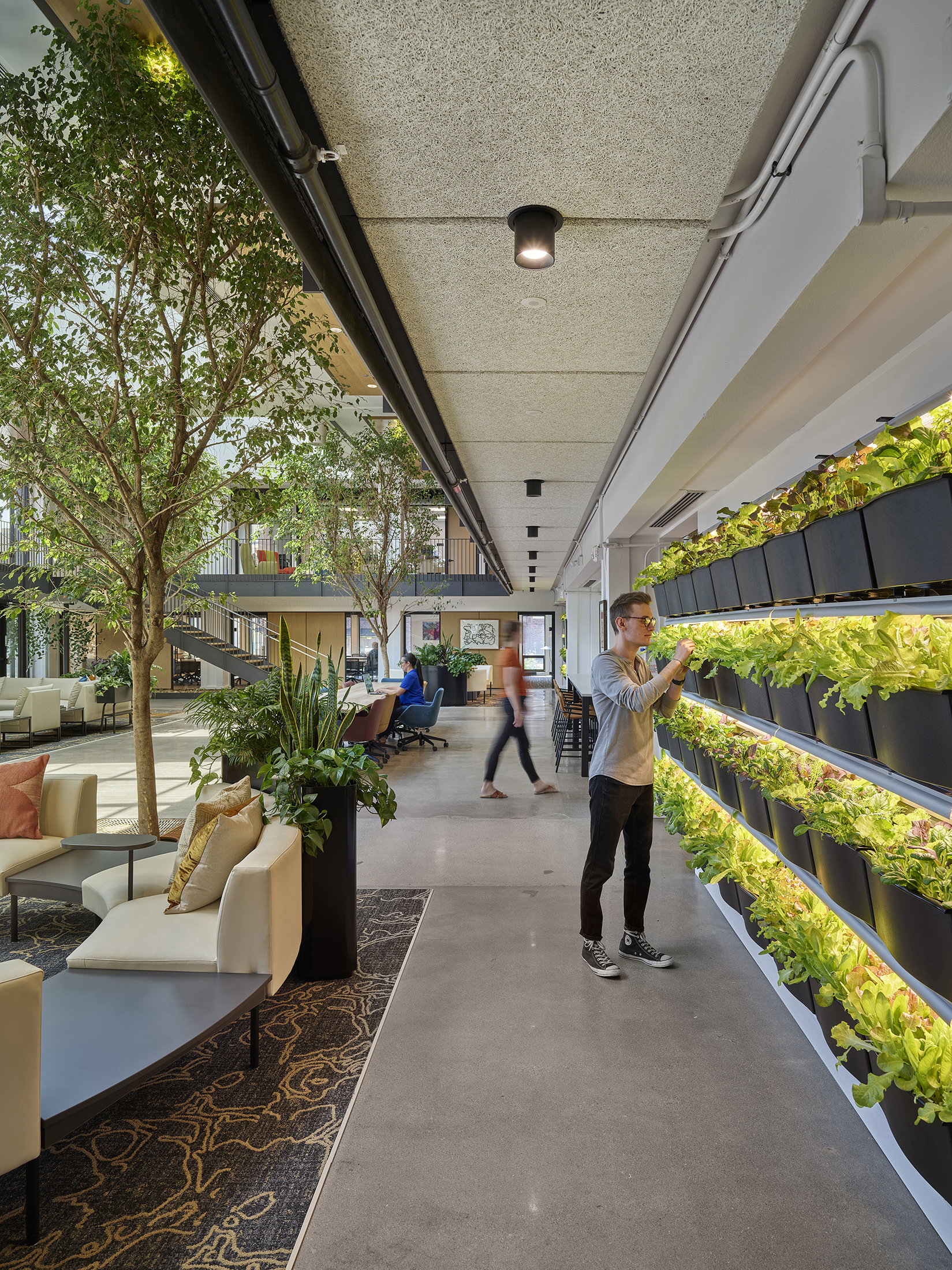
AR: Recently, y’all worked on the Living Building Challenge and certified Stanley Center. That’s the most rigorous sustainable certification we have in the world. I’m sure it put y’all through the ringer as well. Tell me about that? How do you match product to a project that’s aiming for such a high standard?
LB: When we started on the Stanley Center, we didn’t know. We had no idea. We have been working towards chemical transparency in all of our materials by spend. Working at it from a very high organizational perspective and trying to capture all the supply chain data. We hadn’t translated that to a product at the time. So, when we got the ask from the Stanley Center, we were determined to be in that building and they’re right around the corner from our corporate headquarters. How could we not!
Considering the Living Building Challenge, the organization that they are, and the local partnership that we have, we were determined to make it happen, but it was quite an extensive road to get there.
At the time, we didn’t have a dedicated, huge product sustainability team, so we were all hands-on deck. We had to build a team, come together and make sure we were getting the information from suppliers. We had to work with Iowa State to do testing of our product and then we had to remove PVC that we found in the product and find alternatives. Each project is slightly different, right?
The Ripple Effect of Sustainable Practices
We are there to work together with our clients and really find the solution. I don’t think there’s a one size fits all. It really depends on what their goals are and what they’re trying to achieve. The beauty of it is, it might push us to really focus on an individual product that they’re concerned about.
It’s not that we weren’t thinking about it. Maybe we were just taking a different approach. The other piece that I really want to call out is the trickle-down effect from our customers to us also extends to our supply chain. Stanley Center was a great example of that, where we started that outreach with suppliers andthey said that we were the only ones asking for that. And now they’re coming to us with innovative ideas. That shows that we are really making a dent and making success here. That is the most exciting thing.
MG: Yeah, I think from my perspective on the Stanley Center project, what really stuck out to the architectural products team, is it forced us as Allsteel and HNI to look in the mirror and say—how can we do better?
The sign of a great collaboration with our clients is holding each other accountable to constantly achieve these goals together. With architectural products, as just one example for us, we tested tens of thousands of individual parts to understand the chemical makeup. Now we can proudly say that we are Red List–approved and Declare-labeled for our entire architectural products portfolio.
AR: For so long, sustainability was very organizationally driven. How can our organization do better for our operations? But then you find out that what you do in your organization has this upstream impact on your clients and a downstream impact on your own supply chain. Then you start to become a node in change happening across the supply chain.
I think with furniture, it is really powerful when that happens. There’s just, there’s such a large network of people involved in this industry and I think we can make real change happen.
Listen to the full “Furnishing a Better Future” episode on the Surround Podcast Network.
Latest
Projects
Inside and Outside Johns Hopkins’ New Bloomberg Student Center
Inside the New BIG and Rockwell’s Bloomberg Student Center At Johns Hopkins, a new student center reconnects the university to Baltimore and redefines how students gather, collaborate, and unwind.
Viewpoints
Archtober and the AIA Center for Architects Invites You to Share Space
Archtober 2025: Sharing Spaces, The 15th edition brings together architects, artists, and the public for a month of events exploring how New Yorkers share and shape their city.