


September 23, 2025
Brutalist Plaza in Minneapolis Gets a “Surgical” Redesign
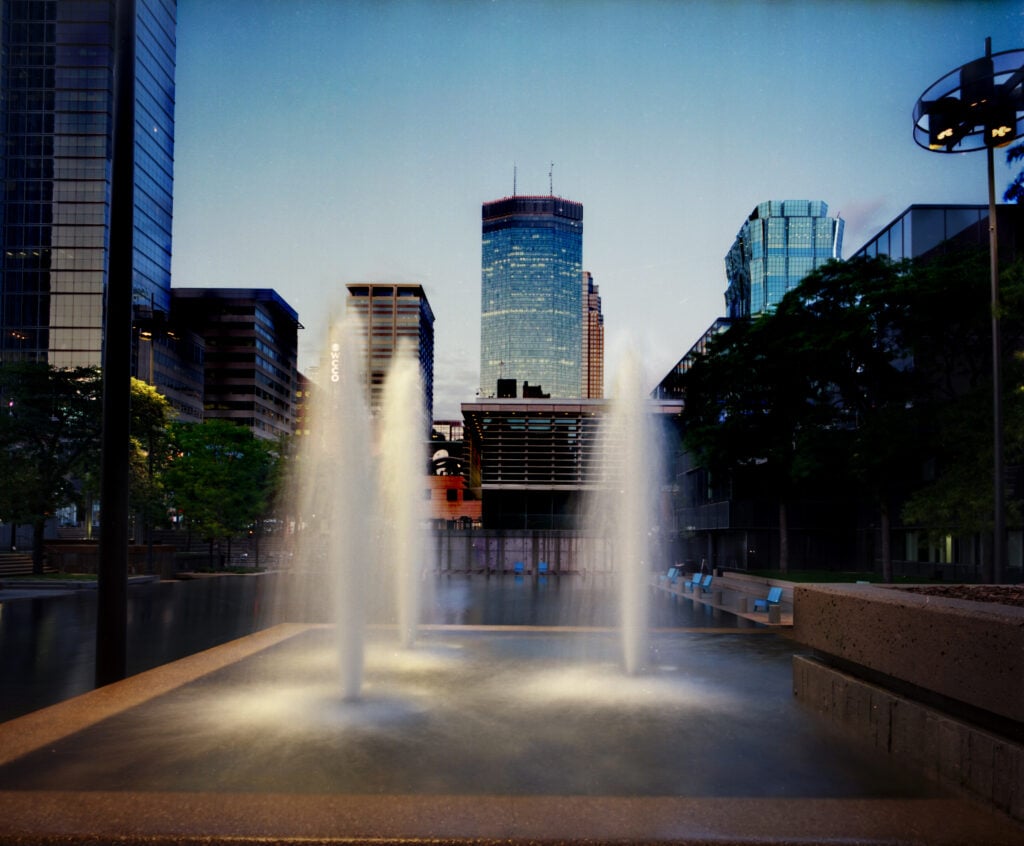
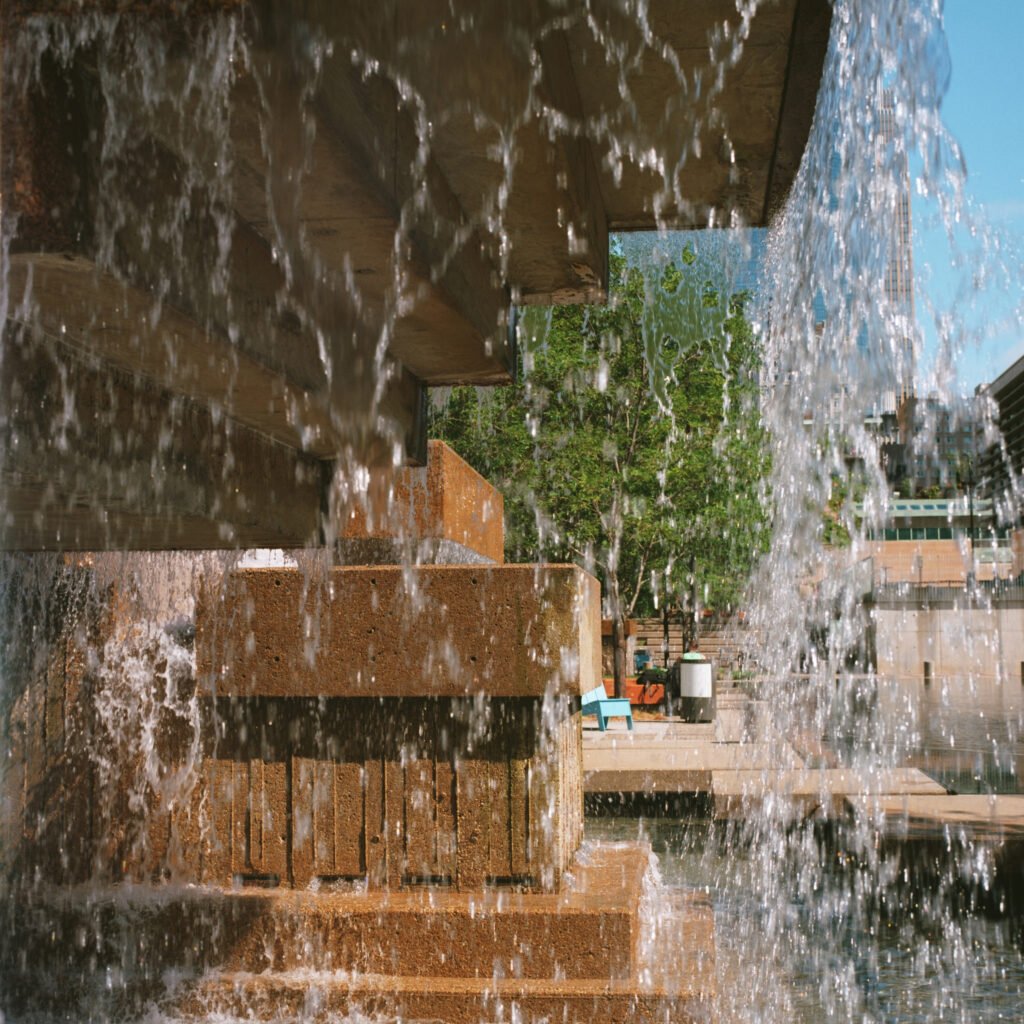
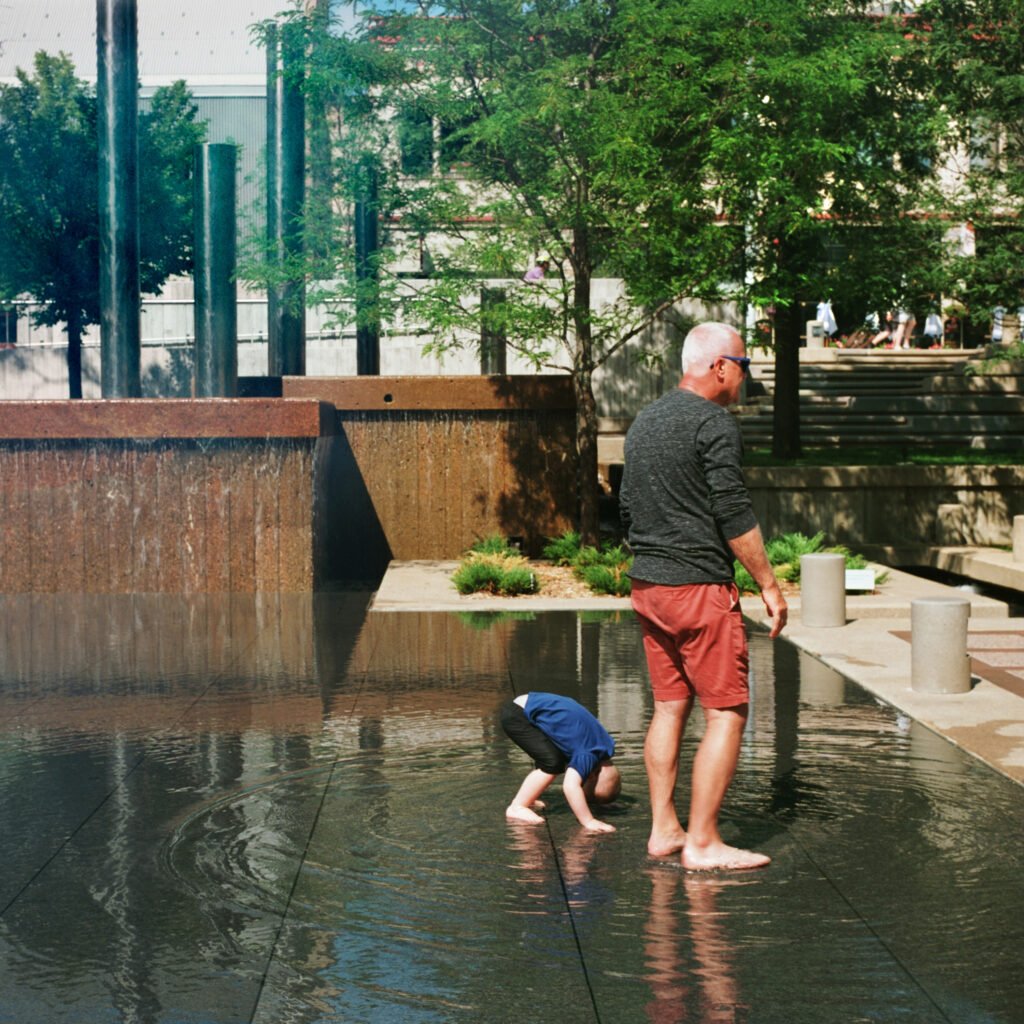
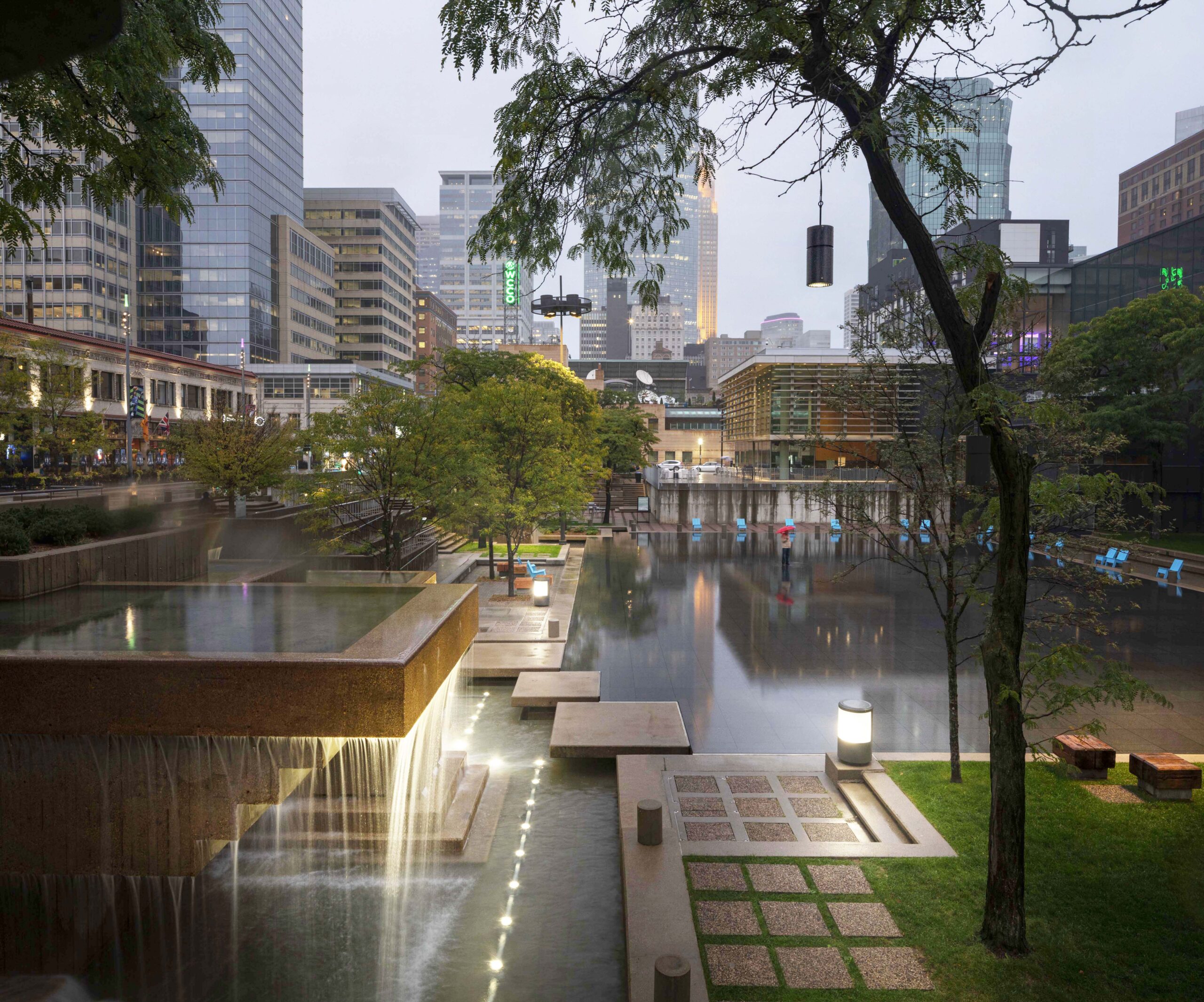
Peavey Plaza would become one of the most potent expressions of Friedberg’s ideas. Built from the remnants of a two-acre excavated pit that had been used as a staging area for the construction of Minneapolis’s Orchestra Hall, the space featured a large central wading pool, surrounded by terraced fountains, planting beds, and amphitheater-like seating. The sound and sight of the rushing water offered visitors a rare connection to nature in the heavily urbanized environment, allowing for informal play in the summer and ice-skating in the winter, while the pool basin could also be drained to accommodate public events.
“The water was fundamental as a way to create white noise,” says Robin Ganser, a landscape architect and principal at Coen+Partners, which would eventually lead the rehabilitation of Peavey Plaza. “The volume of water that’s being pushed over that fountain is incredible. It’s so loud that when you’re standing next to it, it drowns out everything else.”
Within just a few years, Peavey Plaza’s novel fountain systems began to experience problems. By 2000, the city stopped trying to repair them, and the plaza lost a major component of its ambiance. Further deterioration followed. In 2010, the city selected a team of Tom Oslund of O2 Design, Charles Birnbaum of the Cultural Landscape Foundation, and a then-almost-80-
year-old Friedberg to rethink the plaza, only to pull the plug on the project less than a year later. In 2012, city council members voted to demolish Peavey Plaza, citing the effects of its own lack of maintenance, as well as accessibility challenges.
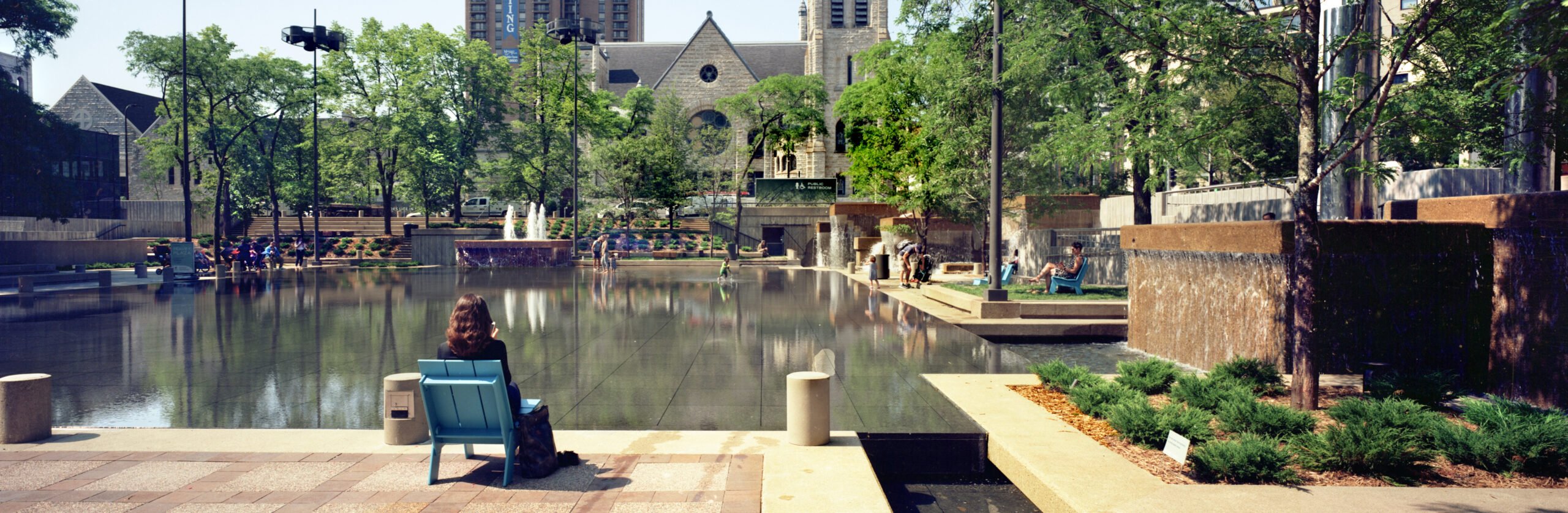
The Preservation Alliance of Minnesota and the Cultural Landscape Foundation, a longtime watchdog organization for historically significant works of public art and landscapes, sued the city, alleging a violation of the Minnesota Environmental Rights Act, which includes protections for not only natural resources but historic ones as well. Meanwhile, the historic preservationists at the local firm Hess, Roise and Company succeeded in placing Peavey Plaza on the National Register of Historic Places. The city eventually agreed to a settlement, which saved the plaza from the wrecking ball and committed city officials to working with preservationists to solve the maintenance and accessibility problems.
A second design effort commenced, this time led by Coen+Partners. Working with Fluidity and a host of other consultants, the landscape architects proposed a scheme that would upgrade the water systems, decrease the amount of water used, and make 85 percent of the plaza ADA-accessible (versus an original 2 percent), without radically altering Friedberg’s original design. In two places, a portion of the wide concrete stairs was converted into a switch-backing ramp that uses board-formed concrete to fit in with the materiality of the existing plaza, and a new central scrim pool replaced the original wading basin, preserving the central water feature but eliminating both barriers to access and roughly 80,000 gallons of water waste every time the city wants to empty the pool and fill it back up again.
“There was no reuse,” Ganser says of the original design. “And there was no stormwater management. Every time it rained, if the basin was full, it just overflowed immediately into the sewer.”
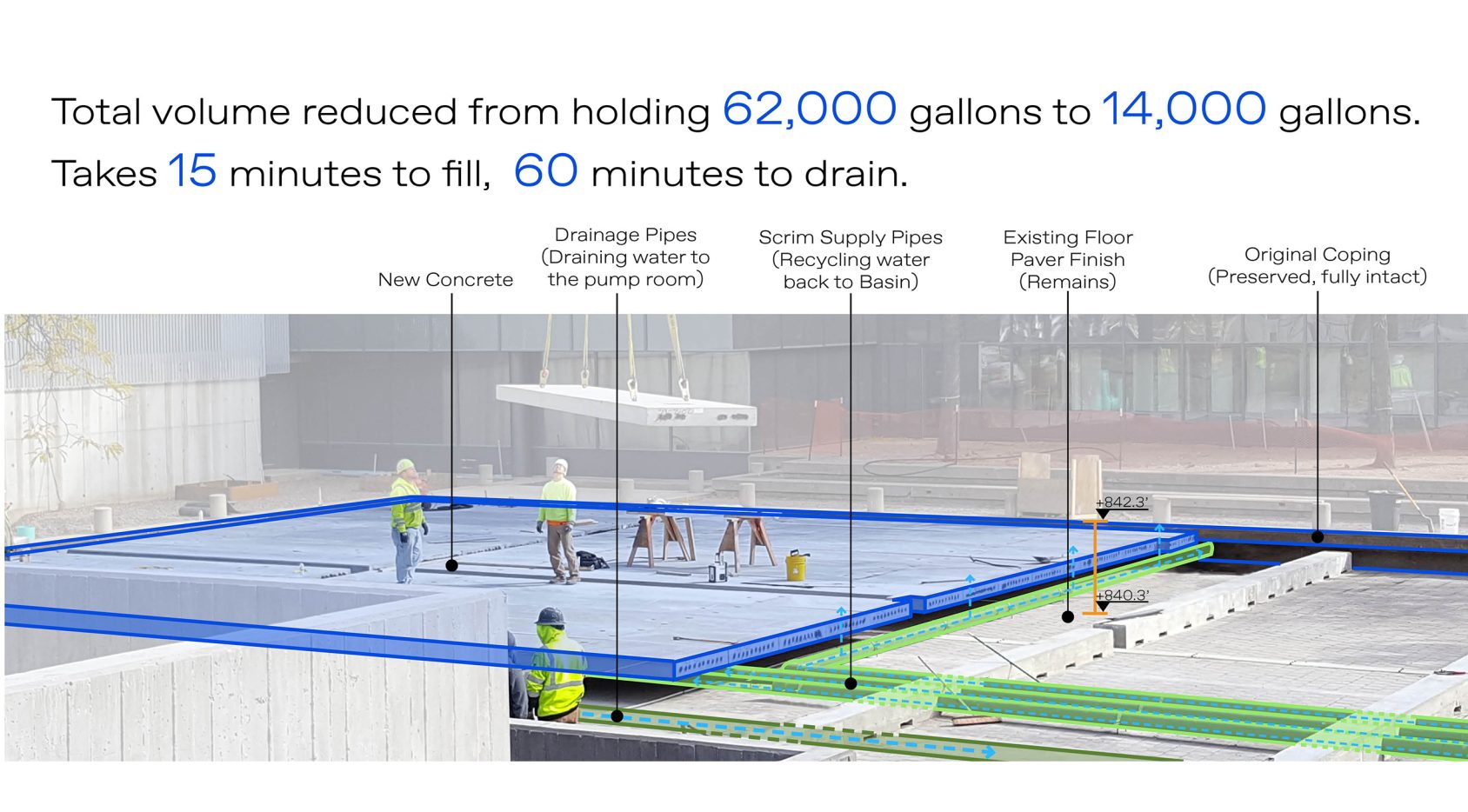
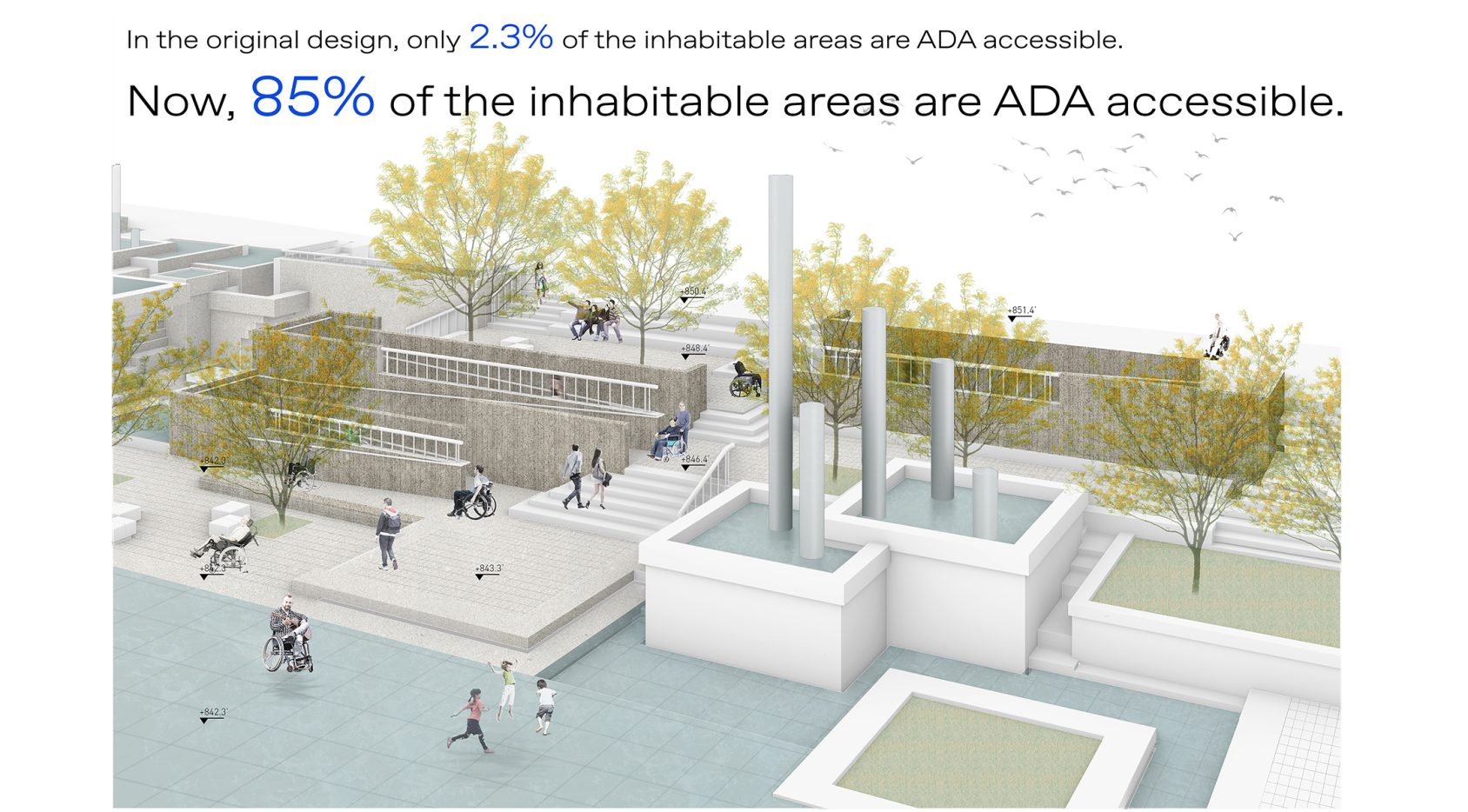
Most compelling were the ways in which the seemingly opposed priorities of the preservationists, the accessibility advocates, and the resource-conscious city departments interwove to create novel design opportunities. To create the scrim pool, Coen+Partners raised the ground plane up by roughly two feet. Even so, Ganser says that “the preservation community insisted on keeping the entire basin intact—all the bricks, the coping, everything—even though we were building [on top of it]. So we took out strips of bricks, poured concrete grade beams, and then laid precast concrete decking over the top of it. It created an 18-inch void underneath so we use that weirdly created void as a stormwater basin.” Coen+Partners designed an inconspicuous slot drain so that, instead of mingling with the water in the scrim pool, runoff flows into the original basin. “It’s actually going to the same place that it always went,” Ganser says.
The Cultural Landscape Foundation’s Birnbaum describes the rehabilitation effort as “surgical.” “It honors what’s there in a respectful way,” he says. “It really is like cutting a diamond. There’s such precision in the project.”
When it opened in 1975, Peavey Plaza represented an ambitious and democratic approach to public space. Its rehabilitation, which won the inaugural Cultural Landscape Award from World Landscape Architecture last year, has not only preserved but enhanced those ideals, creating greater access to Peavey Plaza and its roaring waterfalls, which in this era of a rapidly warming climate might be understood as critical heat-mitigating infrastructure. “Last week, when I was out there, it was 90 degrees and humid outside,” Ganser says, “The scrim and the water falling and the mist as you’re moving past it—the perceived temperature is easily 10 degrees cooler.”
Would you like to comment on this article? Send your thoughts to: [email protected]
Latest
Viewpoints
Bas Smets on Designing Augmented Landscapes
The landscape architect discusses his design for Notre-Dame, this year’s Venice Architecture Biennial, and what he means by biospheric urbanism.

Projects
Kazakhstan’s Almaty Museum Celebrates Central Asian Art
Designed by London-based Chapman Taylor, the project is the city’s first private museum.