


August 18, 2025
Under a Steel Canopy, NVIDIA Unveils a New Kind of Tech Campus
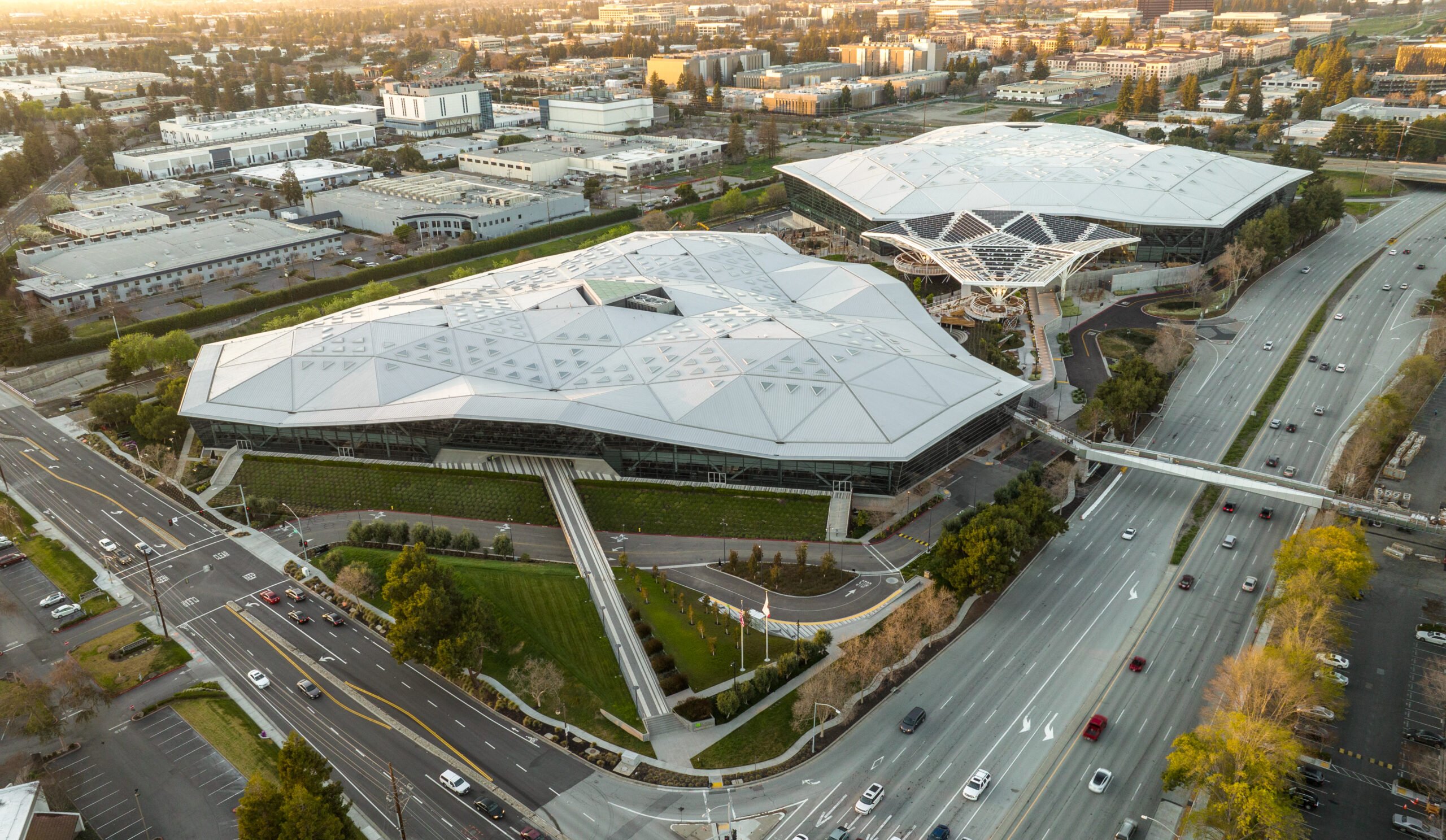
If you’re flying in or out of San Jose, California, there’s a good chance you’ll spot the headquarters of AI-systems company NVIDIA. The two buildings—one roughly triangular and the other hexagonal—with their undulating geodesic roofs, stand out from all the tilt-up structures around them. Designed by architecture and design firm Gensler in two phases, the campus addresses the fundamental Silicon Valley question: How do you get thousands of people to collaborate as if they were working for a start-up?
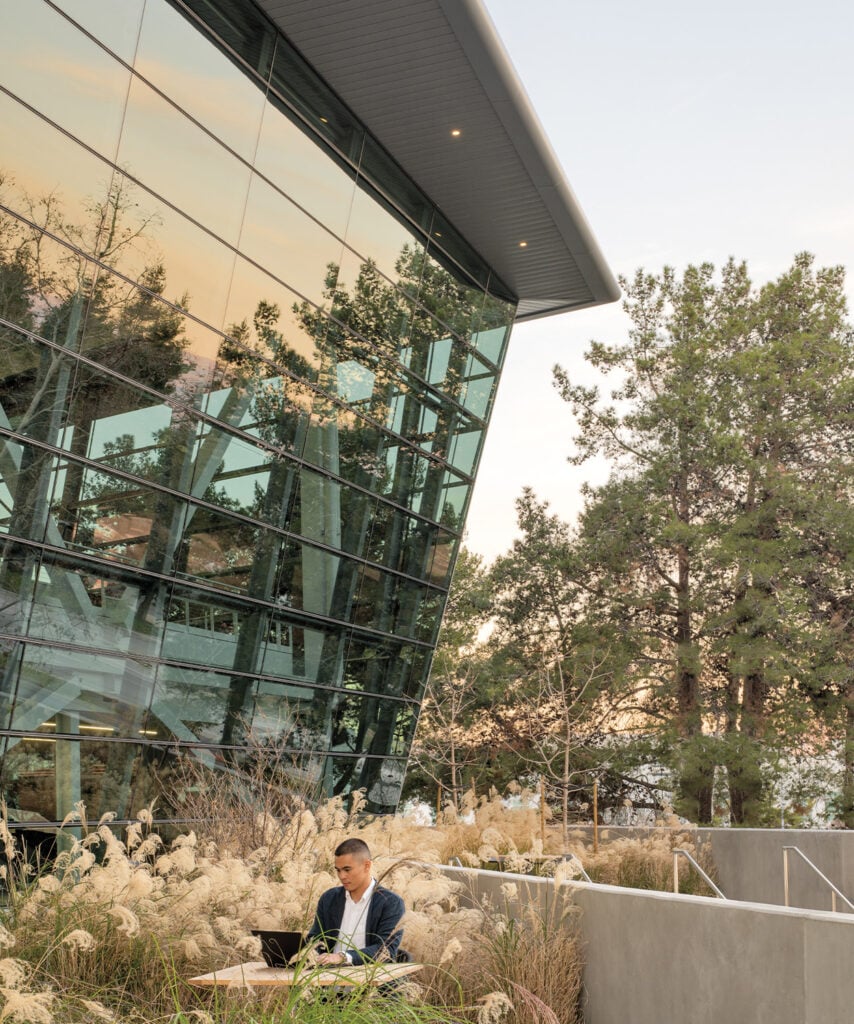
“We were thinking about how to design the best workplace for NVIDIA and how engineers can collaborate, whether it’s indoors or outdoors,” says Hao Ko, principal and Gensler’s global director of design, who notes that the design team began work on the campus in 2012, well before the pandemic. “If you center a design around people, all the other things fall into place.”
An Architecture Inspired by Science Fiction
The first building is commonly referred to as Endeavor, an homage to Star Trek, and features a triangular floor plate with beveled corners. Because the bulk of the square footage is in the center, the shape itself helped people gravitate toward the middle. The three-sided building also freed up more of the rectangular site for open space, a key request from the client. The long sides of both the two-story Endeavor and the more recently constructed three-story Voyager back up to a channelized creek, while the tapered sides, buffered by open space, face a local expressway. Together, NVIDIA’s two buildings encompass 1.25 million square feet and accommodate nearly 6,000 people.
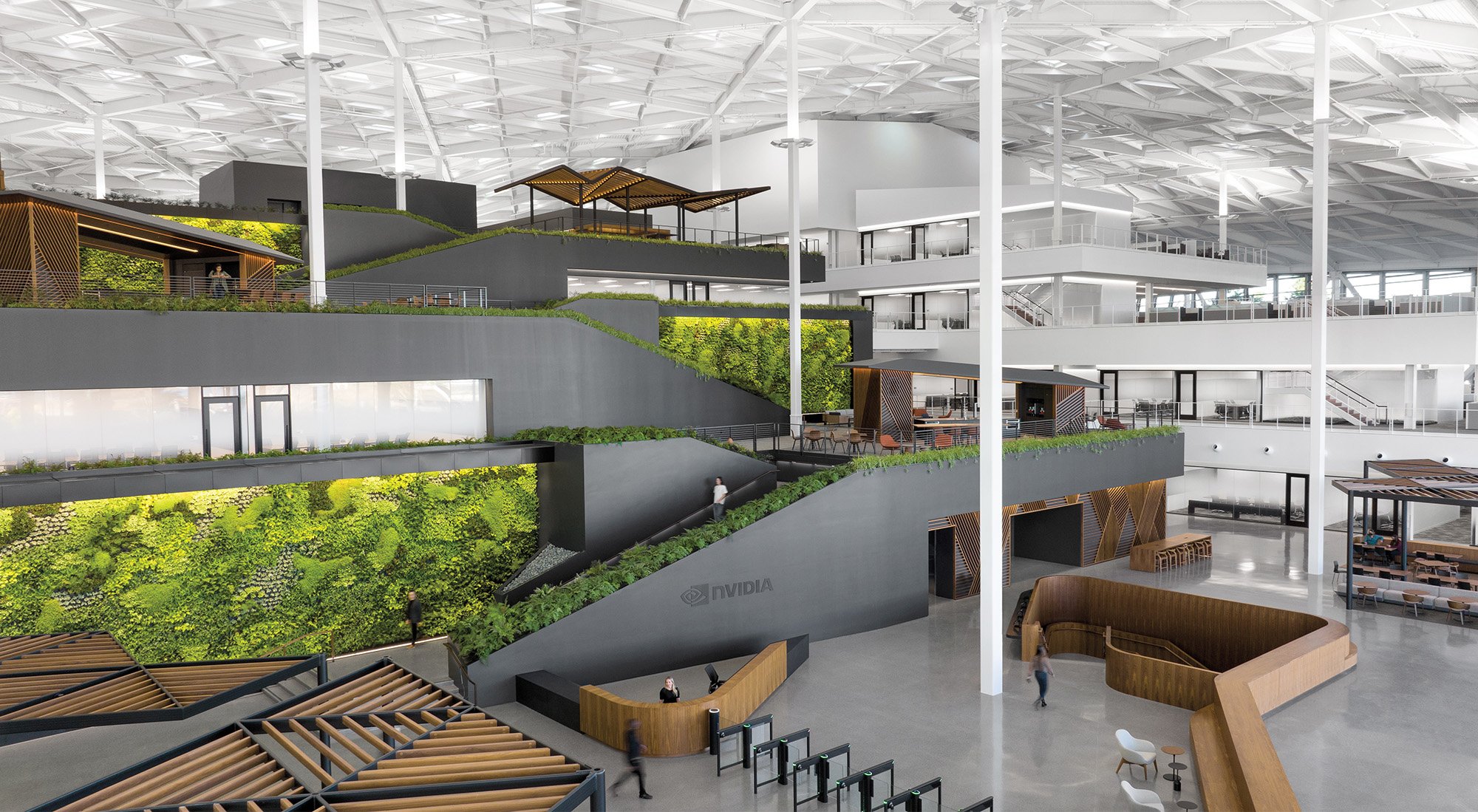
To create the equivalent of one large room, the architects looked for the most efficient structure. “If we could build a room with no columns, that would be the ultimate [approach],” says Ko. A typical office building has 30- or 45-foot spans between columns. To maximize those spans, the design team turned the building into a series of equilateral triangles, creating 70-foot spans in one building and 72-foot spans in the other. The triangular facets of the roof also allowed the designers to shape it in subtle ways, directing the light coming through small triangular skylights and angling it up and down along the perimeter to minimize solar gain.
Material Use for Structural Efficiency and Sustainability
Structural steel was the only material that could provide those span lengths while remaining light enough to be supported by thin columns at the vertices and minimizing the thickness of the horizontal beams for the parking levels below. The lightness of the roof also enabled an efficient and economical method of seismic stability, an important attribute in the earthquake-prone San Francisco Bay Area. Instead of isolating the buildings from the ground, the team designed a reverse base-isolation system in which the roof floats atop support columns that are anchored into the building podium.
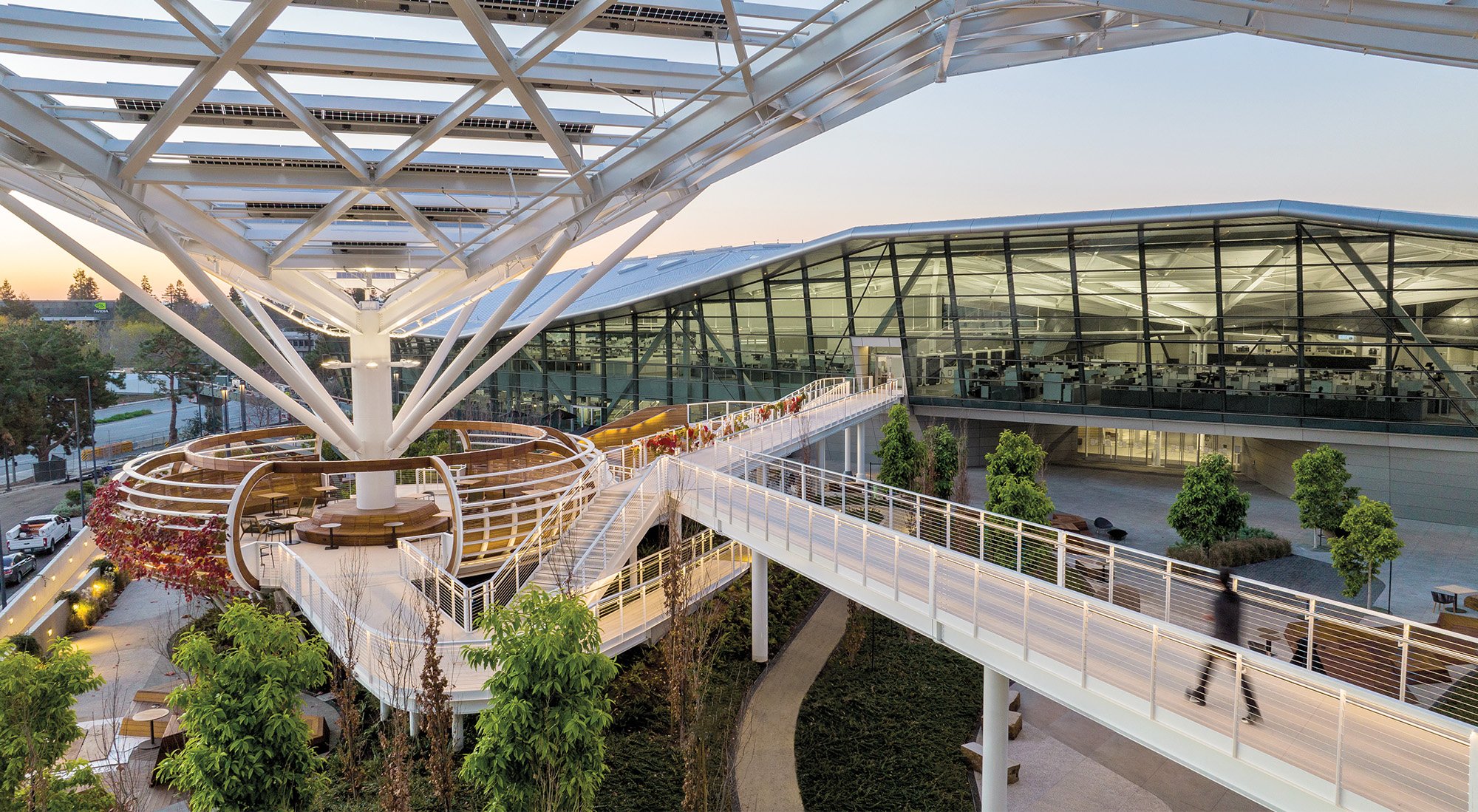
To provide covered outdoor space, the area between Endeavor and Voyager features an enormous metal “tree,” a steel shade structure that is covered in solar panels. The 70-foot-tall trellis has a 240-foot-wide canopy that shades the southeastern side of Voyager, where the NVIDIA campus’s main entrance, tallest glass facade, and café are located. Beneath the trellis are two round “tree houses” that float above the ground level, providing space for about 100 people to lounge or work. The airy, basket like structures are lined with Ipe slats, bringing a residential backyard quality to the project.
A Tribute to NVIDIA’s Legacy
Within, the spaces feel voluminous. The buildings have the grandeur of an airport terminal but are much quieter, thanks to their acoustic perforated ceilings. The white-painted exposed steel structure highlights the lightweight canopy above. At the center of Voyager, the spaces are designed as a “mountain,” terraced with gathering spaces. The back of the mountain functions like an amphitheater during all-hands meetings.
The triangular geometry of the building also neatly underscores the technology that was responsible for NVIDIA’s early success. In the 1990s, the company launched its graphics accelerators, which speedily render 3D worlds for gaming—and the basic shape for these 3D models is the triangle. “It was serendipitous: The geometry serves a purpose for the structure, it signals convergence and collaboration, and it’s an iconic shape for NVIDIA,” says Ko. “That’s when you know this is what the design is calling for.”
Would you like to comment on this article? Send your thoughts to: [email protected]
Latest

Profiles
This Studio is Reworking Indian Modernism by Hand
In Bangalore, Phantom Hands builds a model of sustainability that merges tradition, technology, and ethical design in a living workshop.
Products
Lighting That Lets Shape Shine
From sculptural forms to fixtures inspired by nature—these three lighting trends reimagine how we shape space, mood, and meaning with light.