



July 14, 2025
Insights from the METROPOLIS Leadership Summit at Neocon
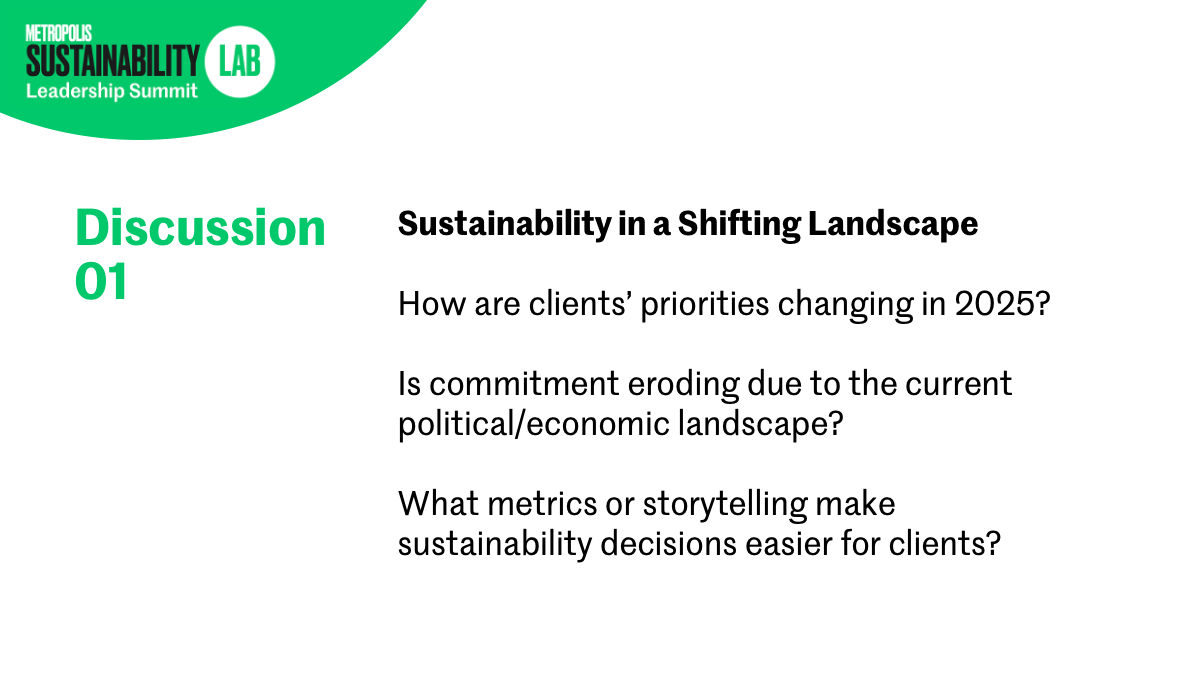
The design industry’s commitment to sustainability has never been more tested—or more vital. As political landscapes shift, how do we maintain momentum toward a more sustainable future?
This question anchored the METROPOLIS Leadership Summit, moderated by editor in chief Avi Rajagopal and editor at large Verda Alexander, held the morning of June 9 during NeoCon. Leaders from across the A&D industry—including educators, advocates, and firm principals—gathered to address the pressing challenges of sustainable design.
In partnership with Mannington Commercial, Material Bank, Formica, Boss Design, Universal Fibers, and Keilhauer, the METROPOLIS Leadership Summit brought together representatives from major industry associations, academic institutions, and leading firms for a wide-ranging discussion on resilience, reuse, and the power of collaboration.
Doubling Down on Sustainability
Despite policy changes and shifting priorities, the summit revealed an industry that is holding firm on its sustainability commitments. Several speakers noted a growing resolve among firms to follow through on their goals.
“There’s been a 9 percent uptick in firms that have joined science-based targets,” recalled Brett Gardner, director of sustainability at IA Interior Architects, citing a report by PWC. “From our firm’s perspective, companies that have made commitments are going to double down.”
Summit attendees also discussed how many educators are now restricted from using words like “sustainability” and “climate change” in their curricula—a challenge that has prompted innovative pedagogical approaches and revealed the industry’s adaptability.
“The words aren’t as important as outcome,” said Sandi Rudy, director of interior design at Cushing Terrell. “As long as the projects incorporate the solutions that the students or practitioners want, you can get around dialogue.”
ASID‘s CEO Khoi Vo echoed the same sentiment, emphasizing that “everyone is still very committed to the cause, and I think that says a lot about the value of the practice that we’re doing. We’re willing to change the vernacular if we have to. We might be going through our syllabus and having to change wordings, but the principles are all still there.”
Reframing and Scaling Reuse
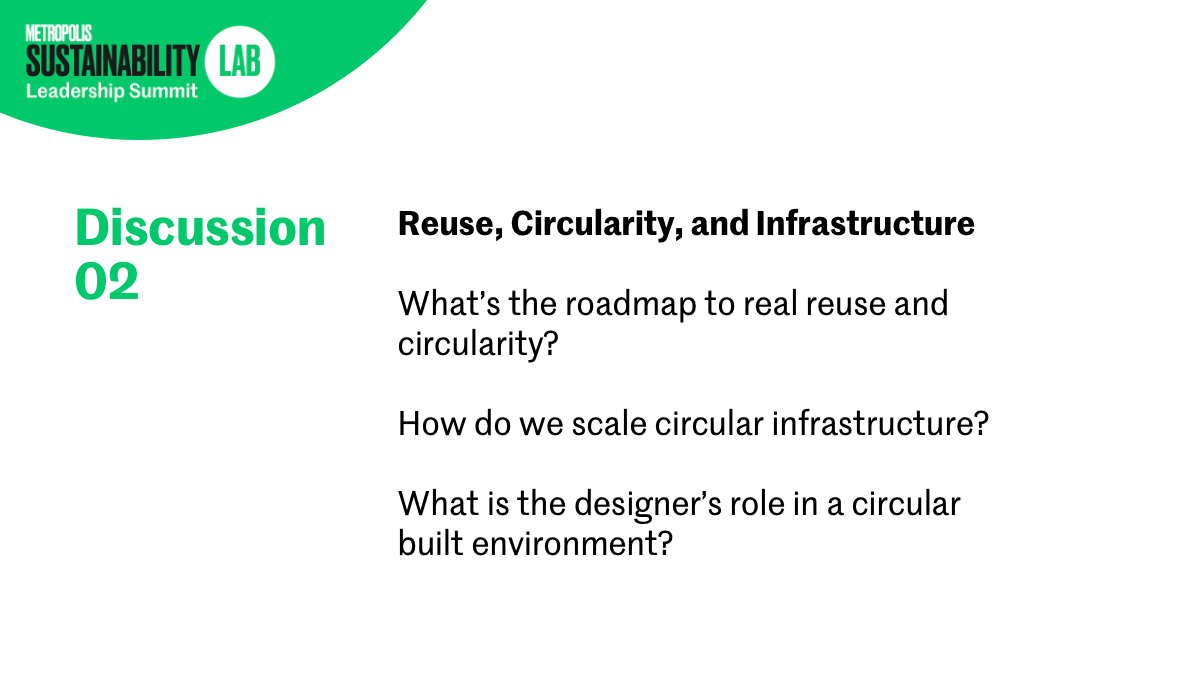
One of the summit’s most powerful conversations centered on scalable strategies for reuse. Jack Rusk, cofounder of C.Scale, shared a compelling example of how reframing reuse can shift client perspectives. He recalled a story from Jenn Chen of LMN Architects in Seattle who was working on a major office renovation. The client wanted to pull out everything—they wanted something new and fresh and exciting. In response her team put together a look-and-feel board with all the finishes the client was excited about.
“The client loved it,” Rusk said. “They said, ‘This is really exciting—it’s going to be a great refresh. Chen then clarified that the carpet spot on the look and feel board was the carpet that was currently in the office.” It wasn’t meant to be a gotcha moment, he explained, but it helped the clients see that the existing finishes could work in a new design.
Building on that idea, Bill Bouchey, design director at Gensler, shared their “70/30 approach”—a guiding principle that has “build what matters and respect what was there” at its core. It’s a way to reduce environmental impact but also bring budgets down, helping clients see that sustainable approaches can be economically advantageous.
Chelsea Duckworth, materials manager at Living Future championed a grassroots approach to scaling reuse and other sustainable practices. “Go to your city council meetings, talk to your city planners, and talk to waste and renewables departments in your county,” she said, urging everyone to connect with the people in their own communities.
Local-first approaches are gaining traction through organizations like the Lifecycle Building Center and regional build reuse networks. Shane Totten, vice president of sustainability at Mannington highlighted how “adopting deconstruction” ordinances are emerging in both red and blue states, creating opportunities for designers to access regional reuse inventories.

Collaboration: Breaking Down Silos
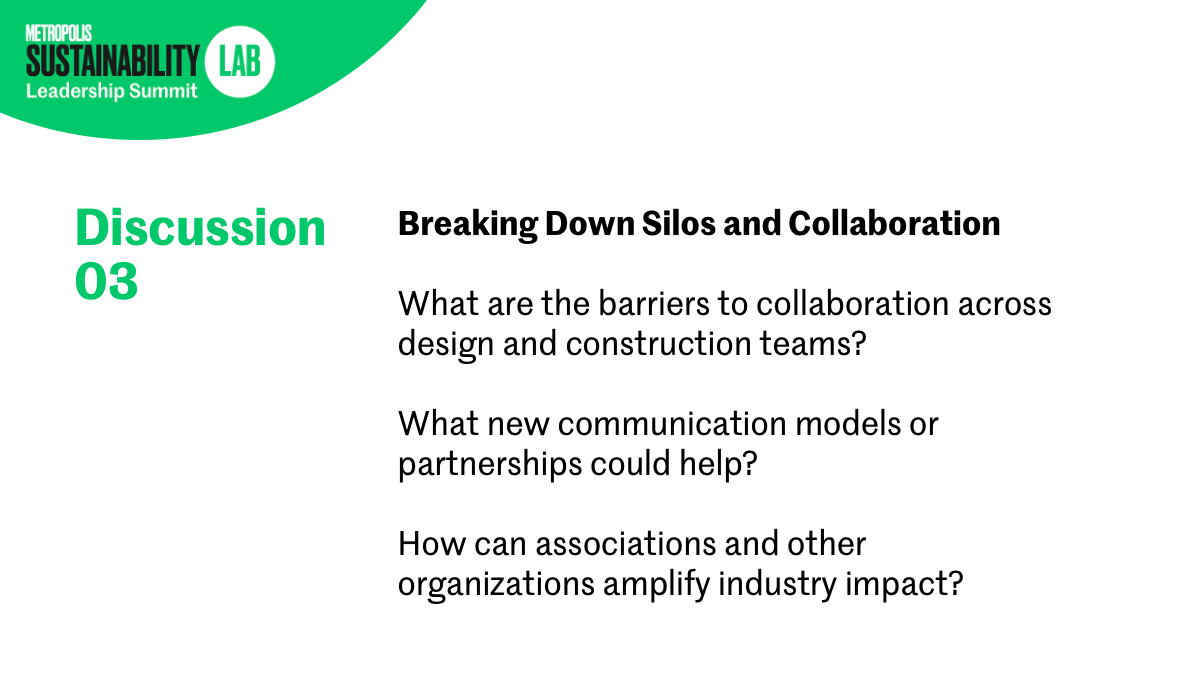
Leaders also grappled with moving beyond ad hoc sustainability implementations to systemic change, when Rajagopal asked the group: “What is going to get us to step beyond this one-by-one kind of scenario? Can we start dreaming of how we get out of this, doing it one project at a time approach?”
This question led to a resounding call for deeper collaboration. “We are a fractured industry,” said Stacey Crumbaker, associate principal at Mahlum. “We should invite the contractors and the developers to be a part of this conversation. We’ve got to bring the other people into the conversation or else it’s just us talking to us, preaching to the choir.”
Collaboration, the group agreed, should expand to students, tradespeople, property managers, contractors, large property owners, architects—all stakeholders who can influence the adoption of sustainable practices.
Participants of the METROPOLIS Leadership Summit included leaders from:
ACT, ASID, BIFMA, Boss Design, CannonDesign, Cradle to Cradle Products Innovation Institute, Corgan, C.Scale, EHDD, Cushing Terrell, DLR Group, Florida State University, Formica, Gensler, HDR, Hickok Cole, HKS, HMC Architects, HOK, IA, IDC, IIDA, IWBI, Keilhauer, Living Future, Mahlum, Mannington, Material Bank, Perkins&Will, Perkins Eastman, Shimoda Design Group, SmithGroup, & Universal Fibers.
Latest

Viewpoints
What Is and Is Not Biophilic Design?
The creator of the concept of Biophilic Design explains effective strategies that keep us healthy by bring us closer to nature.

Products
5 Smart Designs That Boost Brain Function
Discover products that blend neuroscience and biophilic design to boost focus, reduce stress, and support brain health.