



August 14, 2025
Lighter, Smarter, Stronger Metals
In recent years, metals haven’t received the same level of fanfare in architecture and design as materials like wood and biopolymers. This inattention may be partly due to concerns over metals’ high embodied energy. Nevertheless, the material’s practical and cultural significance is profound—as the strong reaction to the recent U.S.-imposed tariffs on steel and automobiles revealed. Furthermore, metal products and processes have shown compelling advances in recent years, offering measurable improvements in the environmental, functional, and aesthetic performance of designs. The following recent developments bolster metal’s innovative contributions to design and construction.
ELYSIS is Revolutionizing Aluminum
A novel manufacturing process known as ELYSIS may not be a household name, but it deserves to be. Developed by Alcoa in collaboration with Rio Tinto, the invention—which the company describes as “the greatest breakthrough in the aluminum industry since the late 1800s”—radically reduces aluminum’s carbon footprint. ELYSIS replaces the carbon anodes used in traditional smelting with proprietary inert materials, eliminating greenhouse gas emissions and releasing only pure oxygen. The BMW Group entered into an agreement with Rio Tinto to incorporate the ELYSIS aluminum process, powered by hydroelectric plants, into its automobile manufacturing operations. According to the company, the process reduces carbon emissions associated with conventional aluminum production by 70 percent.

A New Liquid Metal Technology
Another carbon-reduction innovation assumes the form of liquid metal. A research team led by Sydney’s University of New South Wales (UNSW) engineers devised a method using liquid gallium—which transforms from its solid state above 86°F (30°C)—to convert carbon dioxide into oxygen and solid carbon via a triboelectrochemical process. Requiring only modest electricity and operating at 92 percent efficiency, the method can process a metric ton of CO2 for around $100. A spinoff company, LM Plus, is developing a truck-trailer-sized module to capture and convert emissions directly from industrial processes at manufacturing sites. Paul Butler, the former LM Plus director, explains in a UNSW press release, “This is a very green process which also produces a high-value carbonaceous sheet, which can then be sold and used to make electrodes in batteries or for carbon fiber materials that are used in high-performance products like aircraft, racing cars, and luxury vehicles.”
Developments in Composite Metal Foam
Foamed metals offer promising carbon-reducing capabilities as well as other performance enhancements. Similar to plastic foams, these materials are filled with bubbles, making them unexpectedly lightweight. Composite metal foam (CMF) is made of hollow metal spheres in a matrix of alloys like steel, aluminum, and titanium. The Dr. Afsaneh Rabiei Research Group at North Carolina State University has developed CMF with ultralight, ultrastrong capabilities suitable for a variety of industries demanding extreme mechanical strength. For example, CMF’s effectiveness at stopping armor-piercing bullets is similar to that of conventional steel armor used in military vehicles. However, CMF is half the weight of steel and offers twice the level of protection against fire and heat. These advantages suggest potential design applications with both significant material savings and enhanced protection.
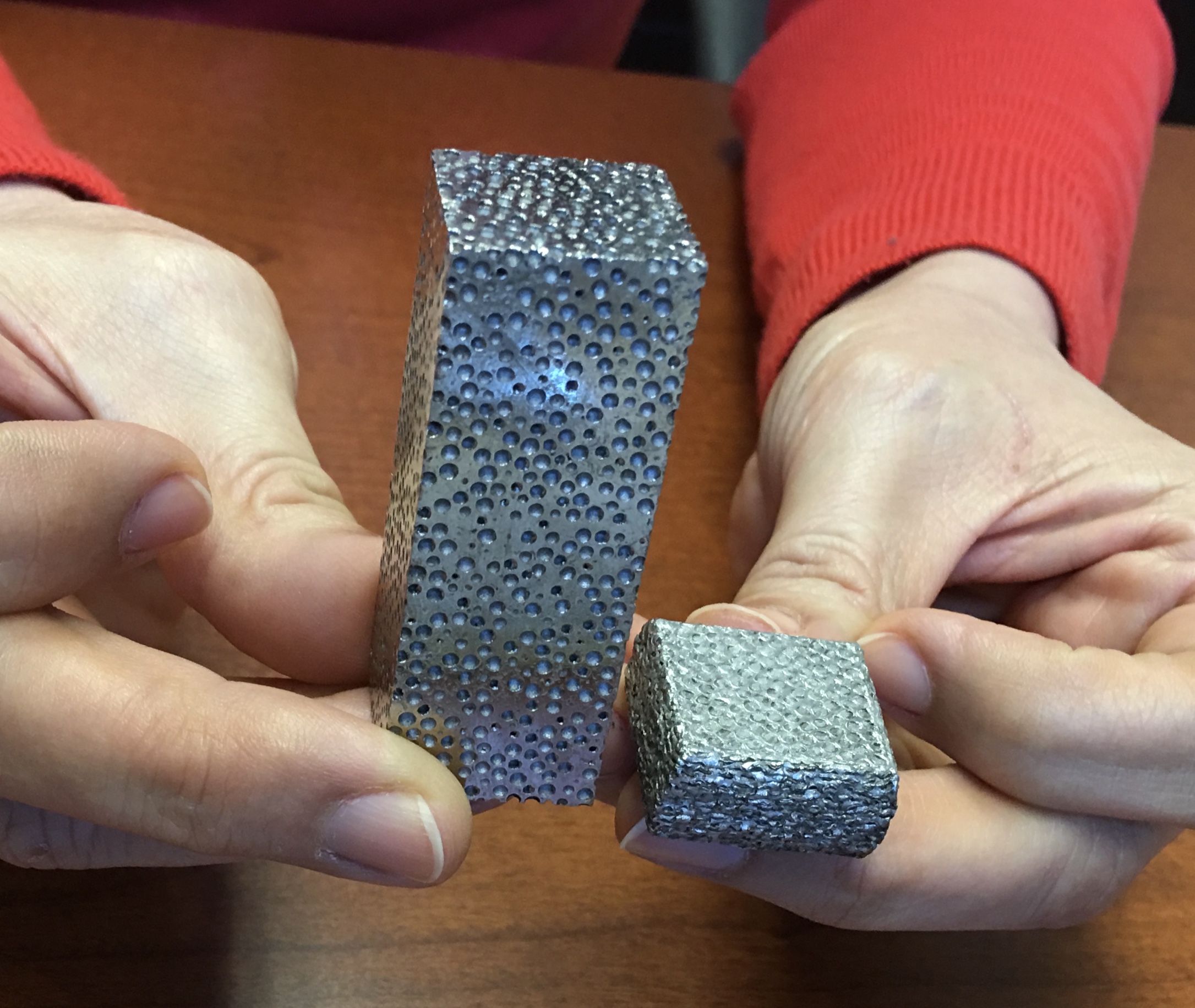
Metal foams’ inherent resistance to heat also presents an advantage for thermal regulation. One of the most rapidly growing needs for this is in computing. The International Energy Agency reports that data centers, cryptocurrencies, and AI are consuming electricity at accelerated rates, and energy demand for computing may reach a breathtaking 21 percent by 2030. Zurich-based Apheros has developed a metal foam that is highly effective in dissipating heat. It’s produced by foaming a suspension of metal particles, which it dries, sinters, and shapes via additive manufacturing processes. The metal foam’s remarkable cooling capability comes from its massive surface area, which is 1,000 times greater than that of comparable foams, and the material is sufficiently porous to float on water. Given that 40 percent of data centers’ electricity use is for active cooling, the substitution of a passive, material-based solution offers clear advantages.
Biophilia-Inspired 3D-Printed Metal Lattice
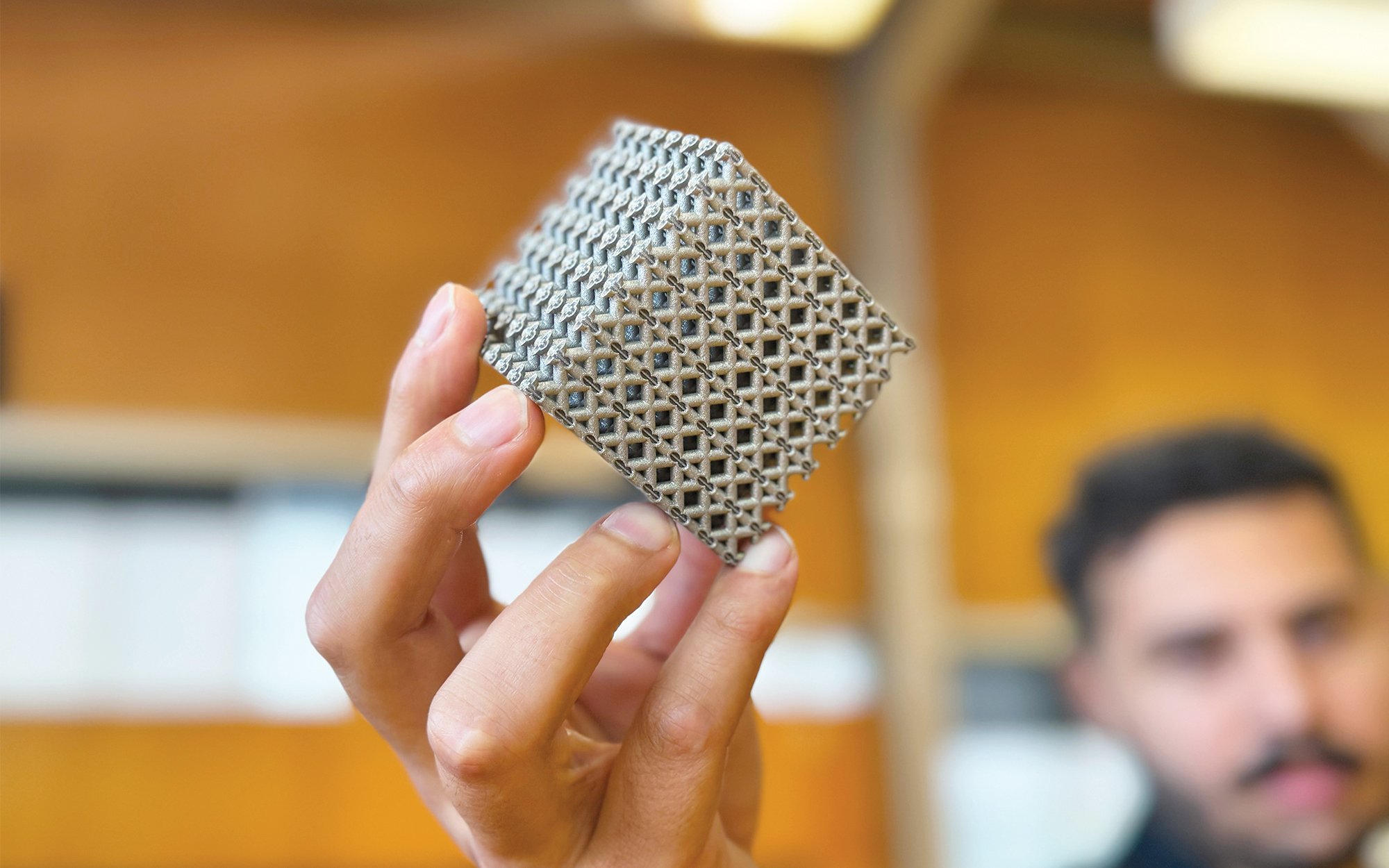
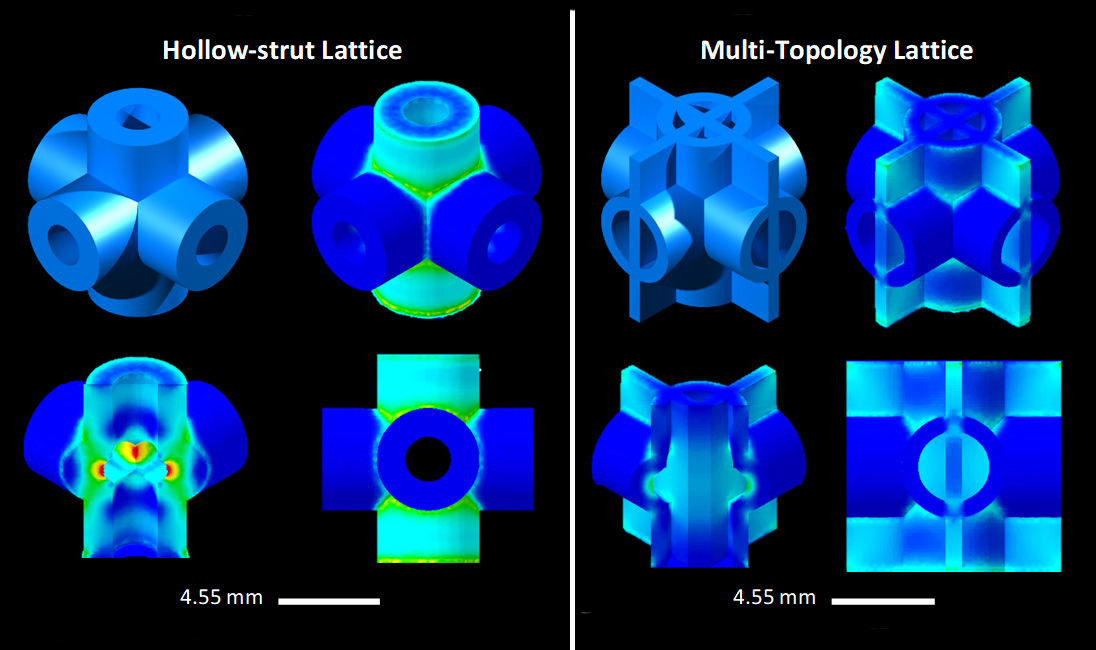
Other porous, additively manufactured metals exhibit extraordinary structural properties. Researchers at RMIT University in Melbourne, Australia, devised a 3D-printing method to fabricate a metal lattice with a superior strength-to-weight ratio. The team studied natural models to achieve unnatural results. Taking inspiration from the lightweight lattices in the Victoria water lily and other hollow-stemmed plants, the researchers developed a lattice structure in titanium alloy optimized for even stress distribution. The resulting “metamaterial,” so named for characteristics not observed in the natural world, boasts a strength enhancement of 50 percent over the next-strongest aerospace alloy of a similar density. RMIT’s research indicates that as the industrial capacity to maximize the strength-to-weight ratio of metals scales to achieve larger volumes, the design of products and building components—and eventually, entire building structures—could be radically transformed.
Would you like to comment on this article? Send your thoughts to: [email protected]
Latest

Projects
Jeanne Gang on Harvard’s New Rubenstein Treehouse
The architect unpacks how material, structure, and openness converge in the university’s first mass timber building.

Viewpoints
Reddymade’s Suchi Reddy on the Architecture of Sensation
Growing research in the field of neuroaesthetics gives us a new understanding of the power of design.