


August 7, 2025
The Blackwell Philosophy Turns Sites into Statements
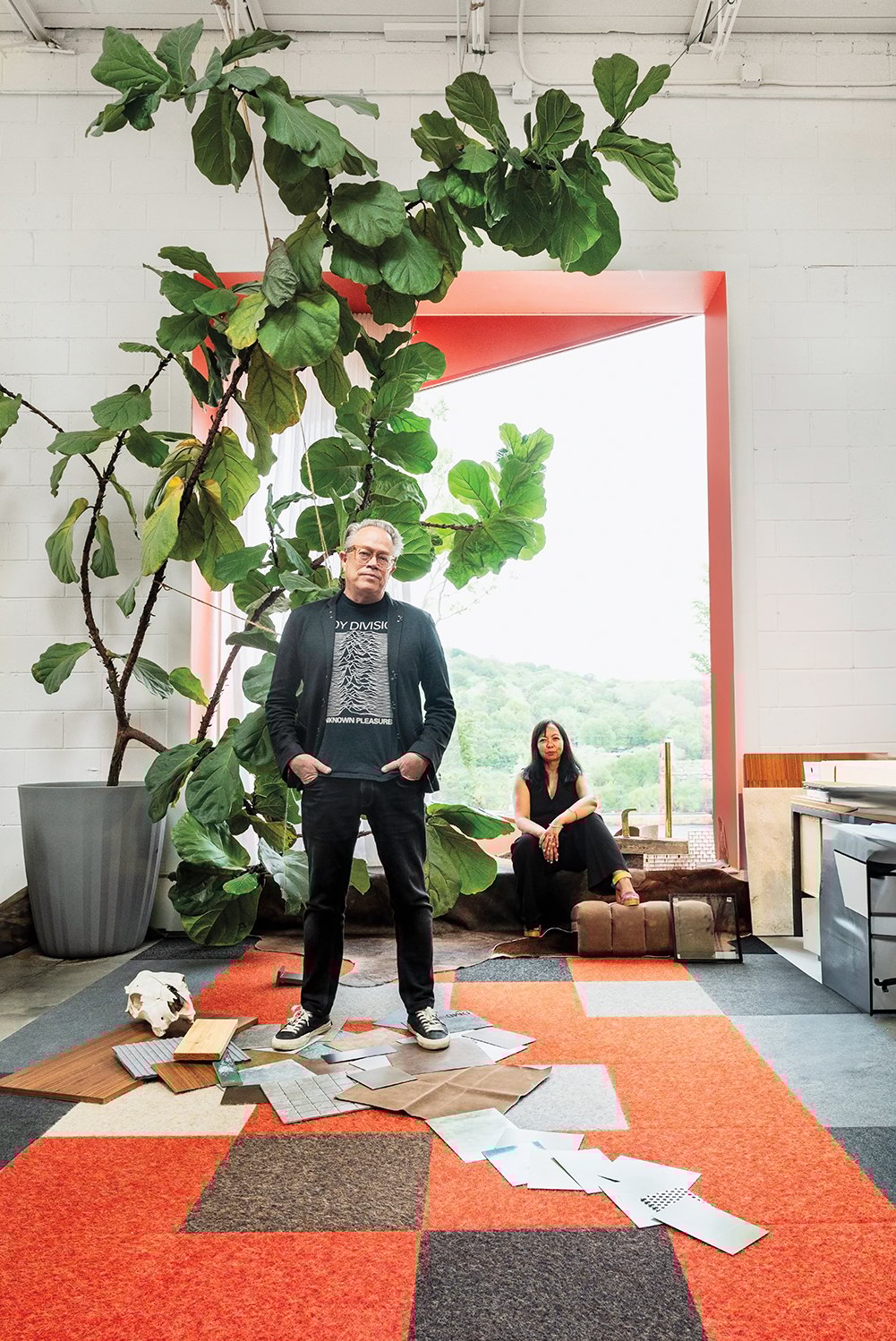
Award-winning architects Marlon and Meryati “Ati” Johari Blackwell fuse influences—geological forms, vernacular building traditions, automotive paint—into buildings that are rooted in the Ozarks but resonate far beyond their place. METROPOLIS editor in chief Avinash Rajagopal sat down with Marlon and Ati to suss out the formulas of this alchemy.
A Study in Contrasts in Arkansas
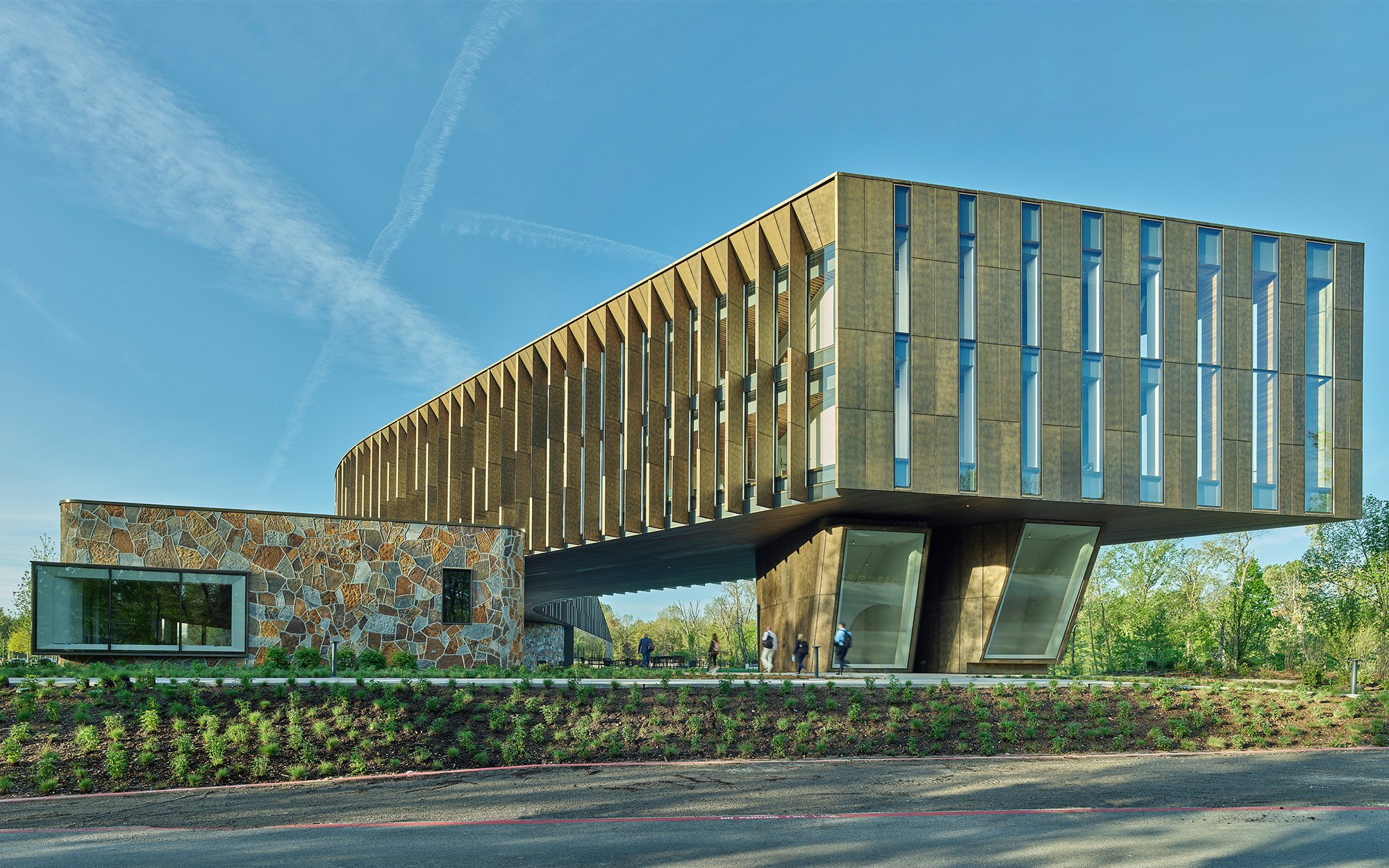
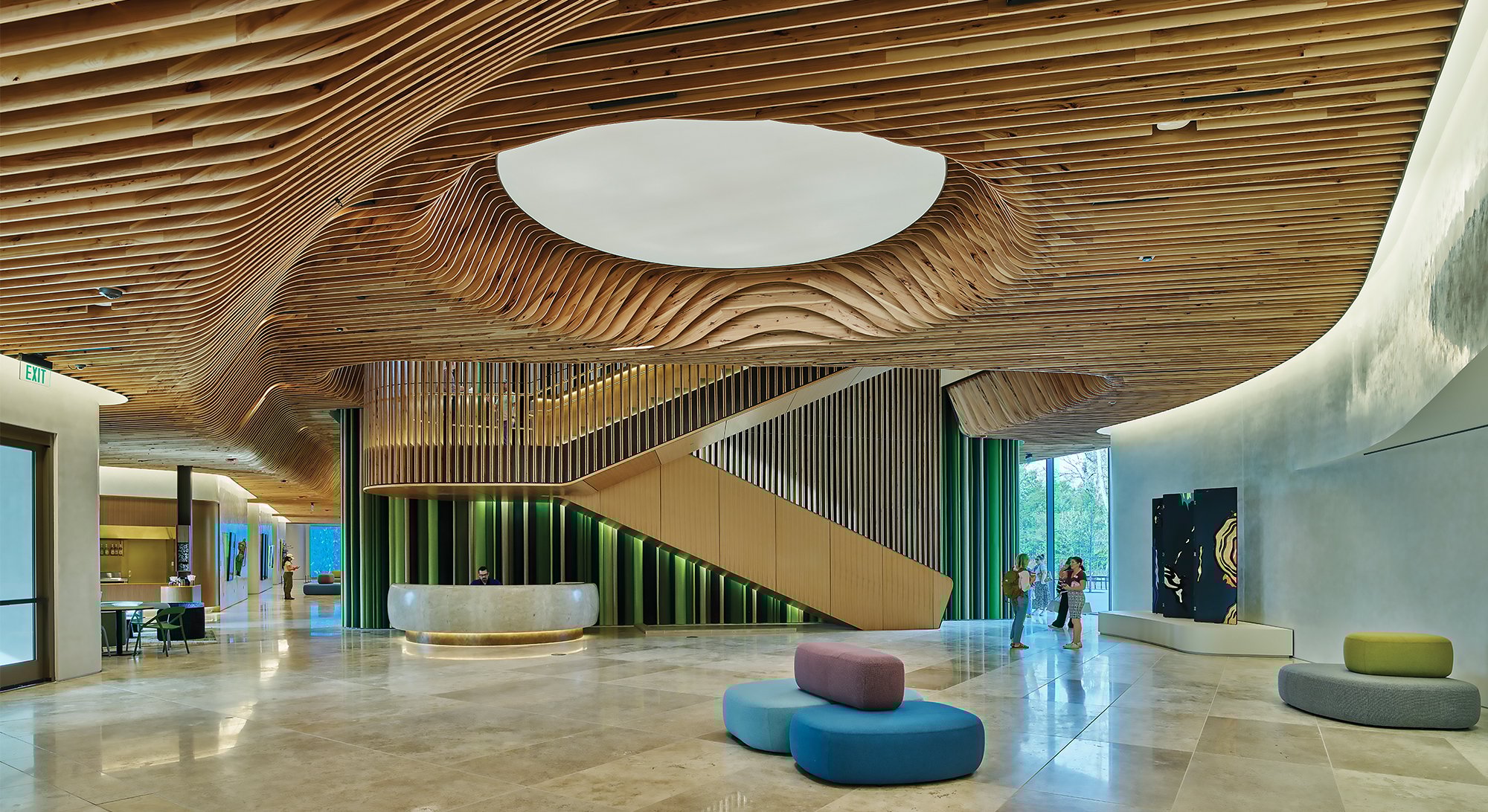
This year, Marlon Blackwell Architects (MBA) completed an 85,000-square-foot building for the Heartland Whole Health Institute in Bentonville, Arkansas. A curvilinear upper floor lined with brass fins sits above structures clad in multicolored fieldstone, echoing the region’s landscape and vernacular buildings. Inside, CNC-milled fins made from local pecan wood paired with green felt create an arboreal ambiance.
Marlon: The idea was to allow it to “speak” to the local topography, the geological [characteristics], and the flora and fauna, the cave and the forest, refuge and prospect. And then we translated all that through the vernacular, with the giraffe stone buildings, these fieldstones, and then putting our own spin on that. We were also thinking about performance and the role of the outer lining of the building in controlling the sun. We have these brass brise-soleil fins that we beveled on the ends to catch the light and the shadow. As the sun moves, they go from light to dark and dark to light.
Ati: I never really quite understood the obsession with long linear buildings in the beginning. But over time, what I came to appreciate, and what I think is a very positive outcome of our really thin and long buildings, is that we get light from both sides.
That’s the most important thing for me. The reason why the building feels the way it does is the light. You get light from both sides, and the light is controlled in some way, so there’s no glare. It’s conducive to work, but when it’s overcast or bright and sunny, you can feel all that, and it changes how you feel inside.
A lot of our buildings have that quality. It’s how we approach sustainability—the whole idea of the building’s placement, the right orientation to take advantage of light and views, prevailing wind, and all that. But what we don’t really talk much about, beyond energy savings and all of that stuff, is how people feel inside.
You can’t go wrong when you have good light.
Avinash: Can you tell me the story of the giraffe stone?
Marlon: Sure, yeah, that’s the local name for it. Many people don’t understand the vernacular, so they might look at it and go, “God, that’s just weird. What are you doing here?” Then, when you tell the story, they’re like, “Oh yeah, I get it.”
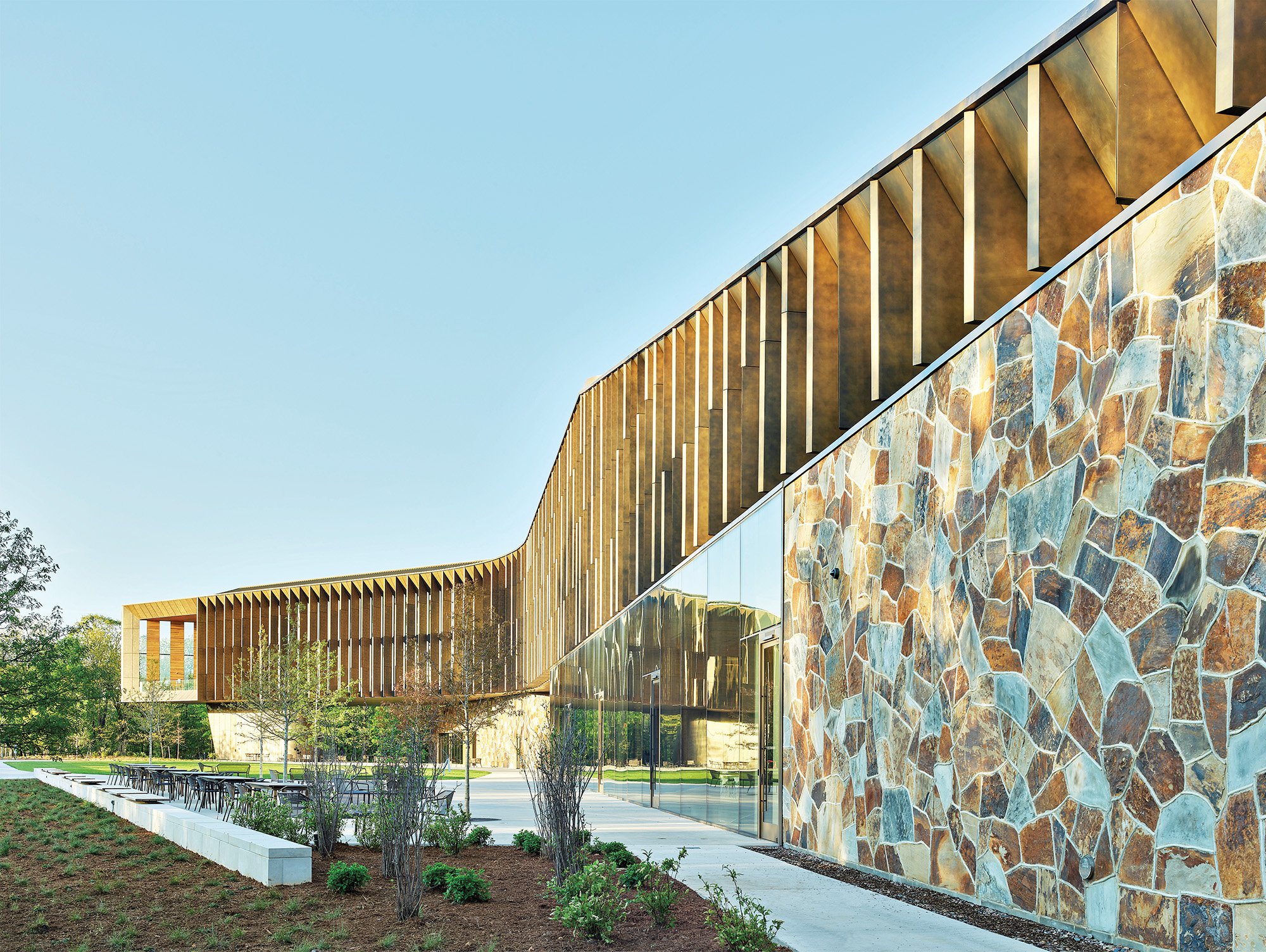
This [giraffe stone] is an example of the self-reliant sensibility in the Ozarks. For stone, you take what’s beneath your feet, right? Thoreau said heaven is beneath our feet as well as above our heads. You take the stone from your fields, and you lift it up. Two people usually can hold it. They’re not professionals, so they use big, thick grout joints so they don’t have to resolve the edges of the stone to each other. And that’s what you see in this area. It’s not designed per se; it’s just sort of assembled together in an ad hoc fashion.
So, in that spirit, we did a similar thing except we shaped it the way we felt it best. We directed the masons to use a special type of joint called a rope joint, that creates shadow patterns on the stone itself, mixing the browns and the grays.
But that for us is the idea of the rock, the cave, the stable base, the anchor to this building that floats above. We contrasted these two modes of assembly. One, a big stone veneer, and the other, above it, an elegant sort of line and plane.
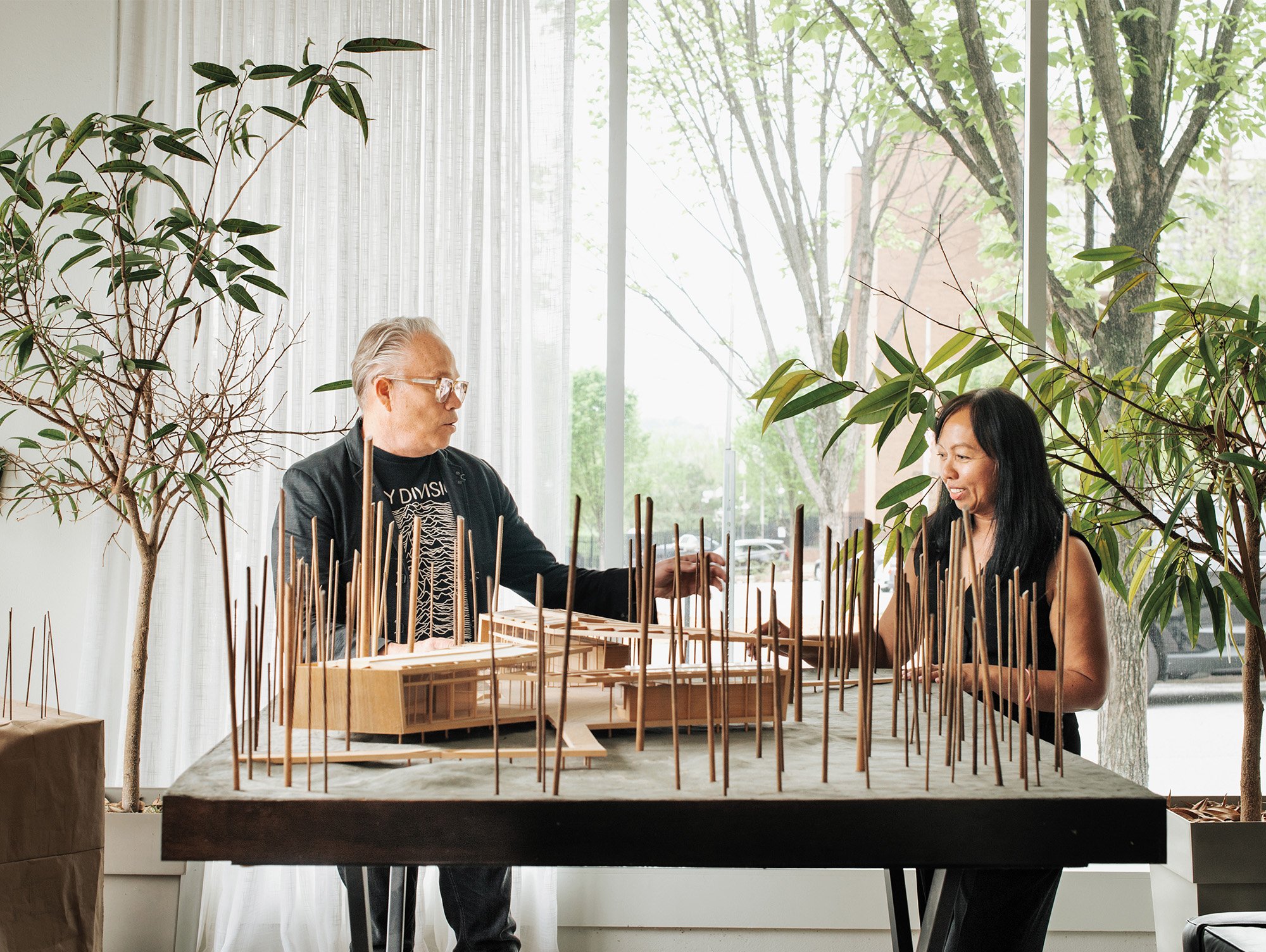
Marlon Blackwell Architects Blends Nature and Culture
Over the years, MBA has designed a number of buildings for the Thaden School, an independent institution in Bentonville. The firm completed the Reels Art and Administration Building in 2019, followed by the Bike Barn in 2020, the Wheels Science and Fabrication Building later the same year, and the Performance Building in 2022.
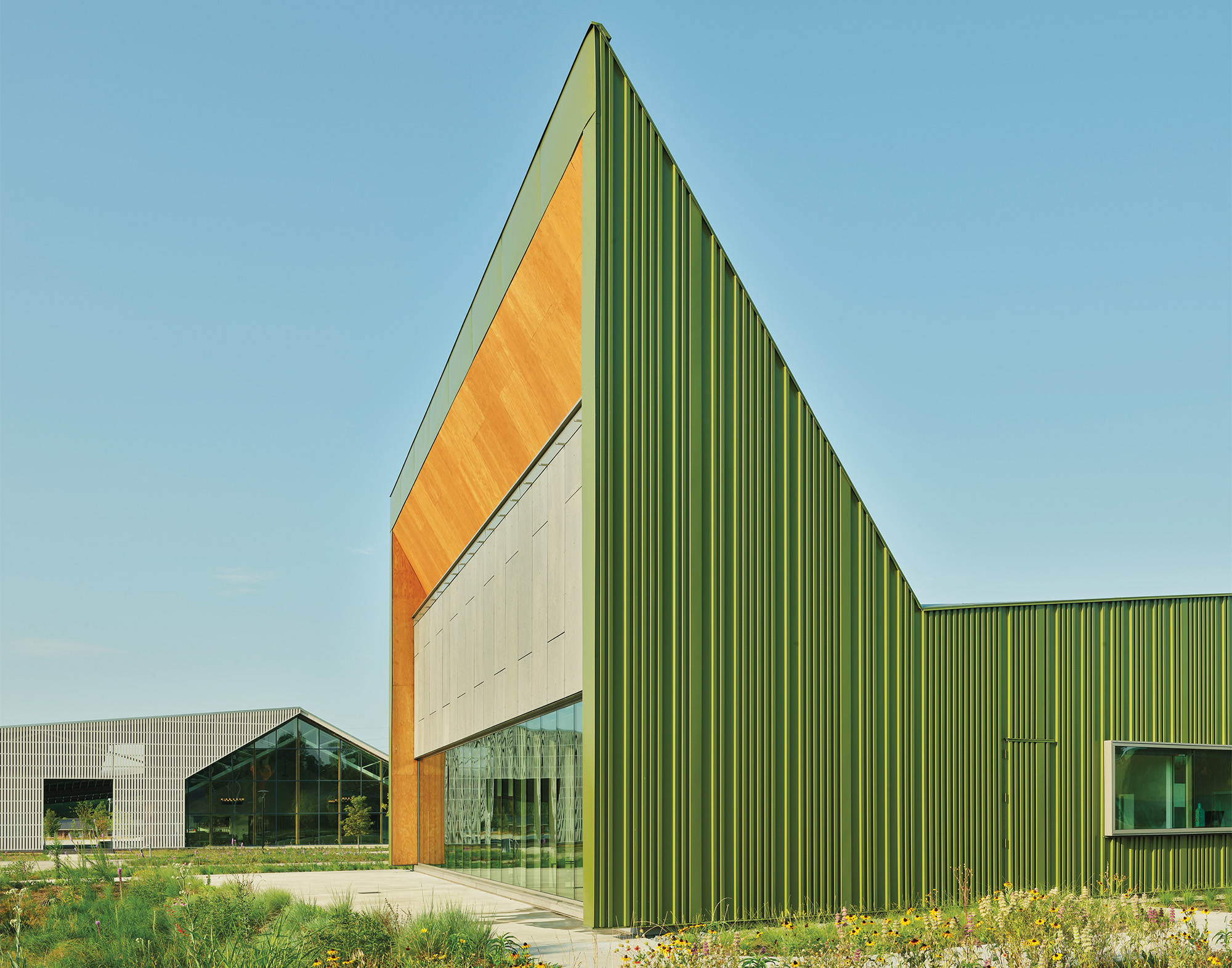
Ati: Marlon Blackwell architecture is a lot about a very strong silhouette in the landscape or a very strong form that is based on something—like chicken houses, in this case. In Northwest Arkansas, our main industry is chicken farming. The way they house these chickens is in long linear structures. So, when we talked about the Thaden School, we talked about a common sense attitude to master planning—something like how a farmer would place the house this way because of the wind, and they would put trees here, and then they would put the barn here to create a farmyard.
Marlon: We’re trying to give you this novel form, but we never talk about it like that. We talk about why it does what it does. Here’s a folded roof pitch and roll. Why are we doing that? Well, we’re trying to keep sectional differences in a one-story building that creates variety, dissimilarity, and even choice in the different classrooms, rather than everything being the same.
Avinash: You often push the envelope on building techniques or material treatments. Even when you use an industrial or off-the-shelf material, you’re doing things that are quite remarkable with it. Tell me a little bit about your process of working with the people who actually build your buildings.
Marlon: No matter what the material is, or how ordinary it is, we try to deal with it through a great deal of care in how it’s placed and precision in how transitions work. In the transitions, in the fascias, at the eaves, and the windowsills, we do custom transition details that allow for seamlessness between the different planes, between roof and wall. And so we’re having discussions with our contractors pretty early on to get them to understand that it’s nothing beyond what they can do; it’s just something that they haven’t done yet.
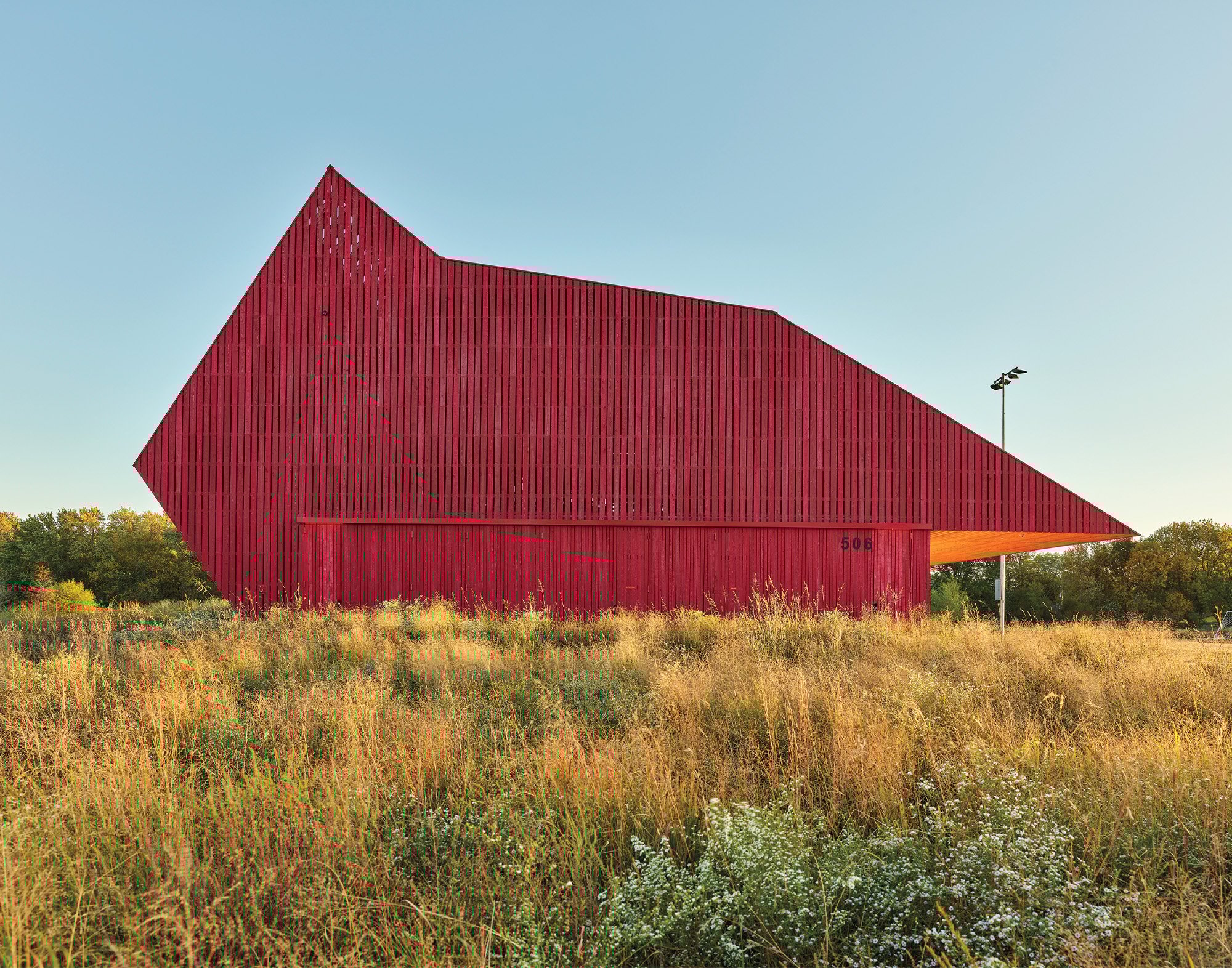
We especially saw that with the Thaden barn. To do that roof, a low-sloped roof like that, requires the right weatherproofing technology. We were working with roofers very early on to figure out how to make these transitions: Where does the water go?
All of that has been resolved and is resolute, because something we’re looking for, always, is a degree of resoluteness between the building in its form and scale, its relationship to the site, but also in relationship to the detail, the scale of the hand. Resoluteness is the goal.
Avinash: You also use color as a way to overlap different ideas in a building. That’s especially remarkable at the Thaden School.
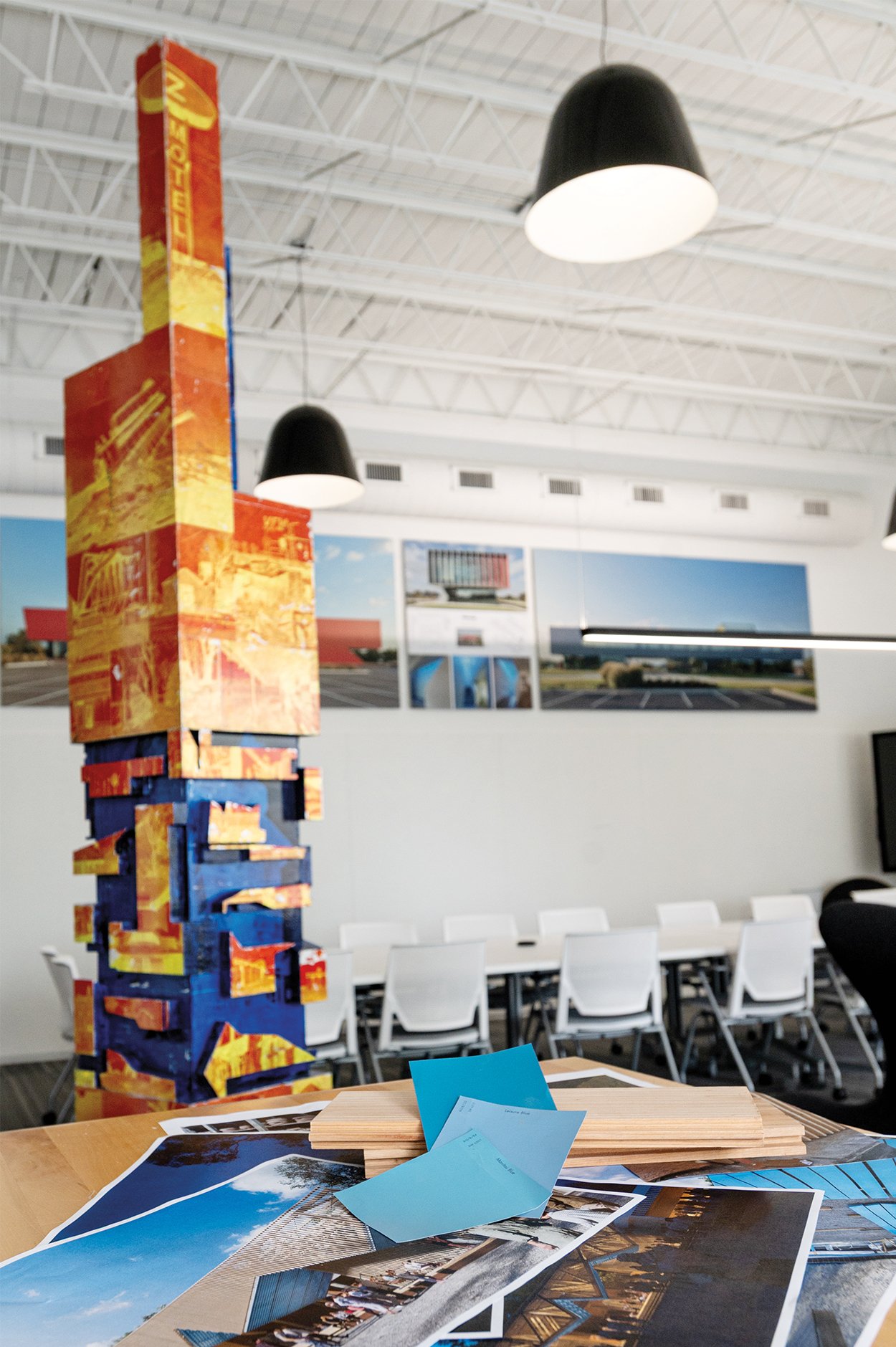
Marlon: It’s part of our love of the intersection of the culture-made with the nature-made. There are patterns that connect these two conditions. In this case [at the Thaden School], the patterns were in color. We knew that the landscape architect had specified Osage prairie grasses. Well, what’s a color that would work with that? The ’67 Shelby GT Cobra, the green gold of that car.
What we discovered is a lot of the paints and the finishes on mobile things are sourced from similar places. Whether it’s a bicycle or a skateboard or a car or motorcycle, all this metal flake was pioneered by Dean Jeffries back in the ’50s and ’60s.
So, we started tweaking those colors to create something distinctive but also somewhat biophilic, helping the building fuse with its landscape at certain times of the year.
How the Blackwells Transcend the Vernacular
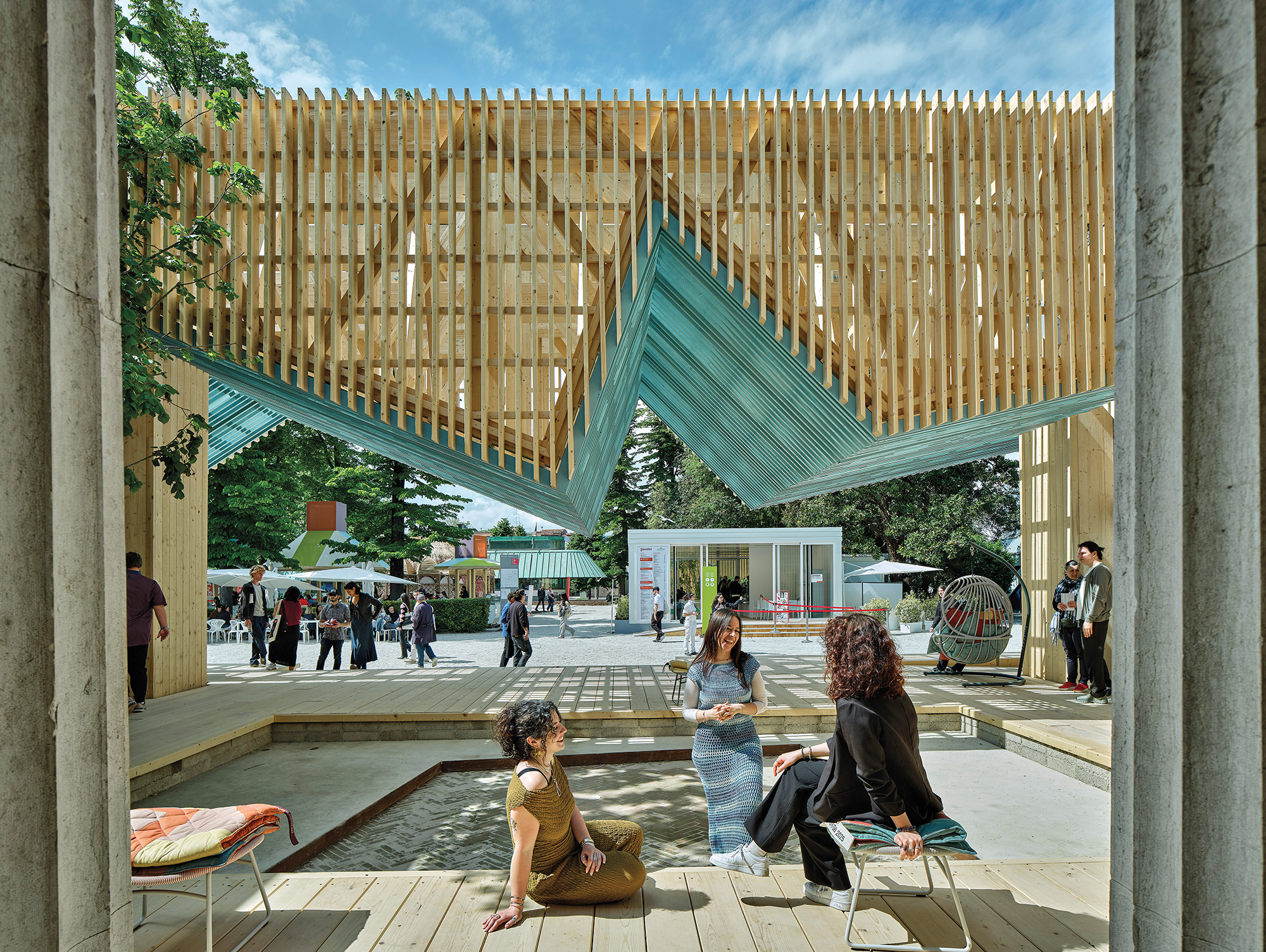
For the 2025 International Architecture Biennale in Venice, MBA worked with D.I.R.T. Studio, TEN x TEN Studio, Stephen Burks Man Made, and Jonathan Boelkins to create a porch for the United States Pavilion—a cantilevered wooden-shade structure with stairs and seating below it to invite visitors to sit and participate in the pavilion’s activities.
Marlon: This really started with [dean of the Fay Jones School of Architecture at the University of Arkansas] Peter B. MacKeith’s idea for the Venice Biennale—a porch, an architecture of generosity. The question was: How do we provide an aspirational representation of the porch as both a stage for life, a kind of proscenium, and a threshold with a civic nature?
It needed to be made out of wood, which makes sense because that’s part of the traditional material of porches. We’re using Austrian spruce, making a superstructure deep inside the courtyard and then cantilevering the entire porch out, so it doesn’t really actually touch the pavilion.
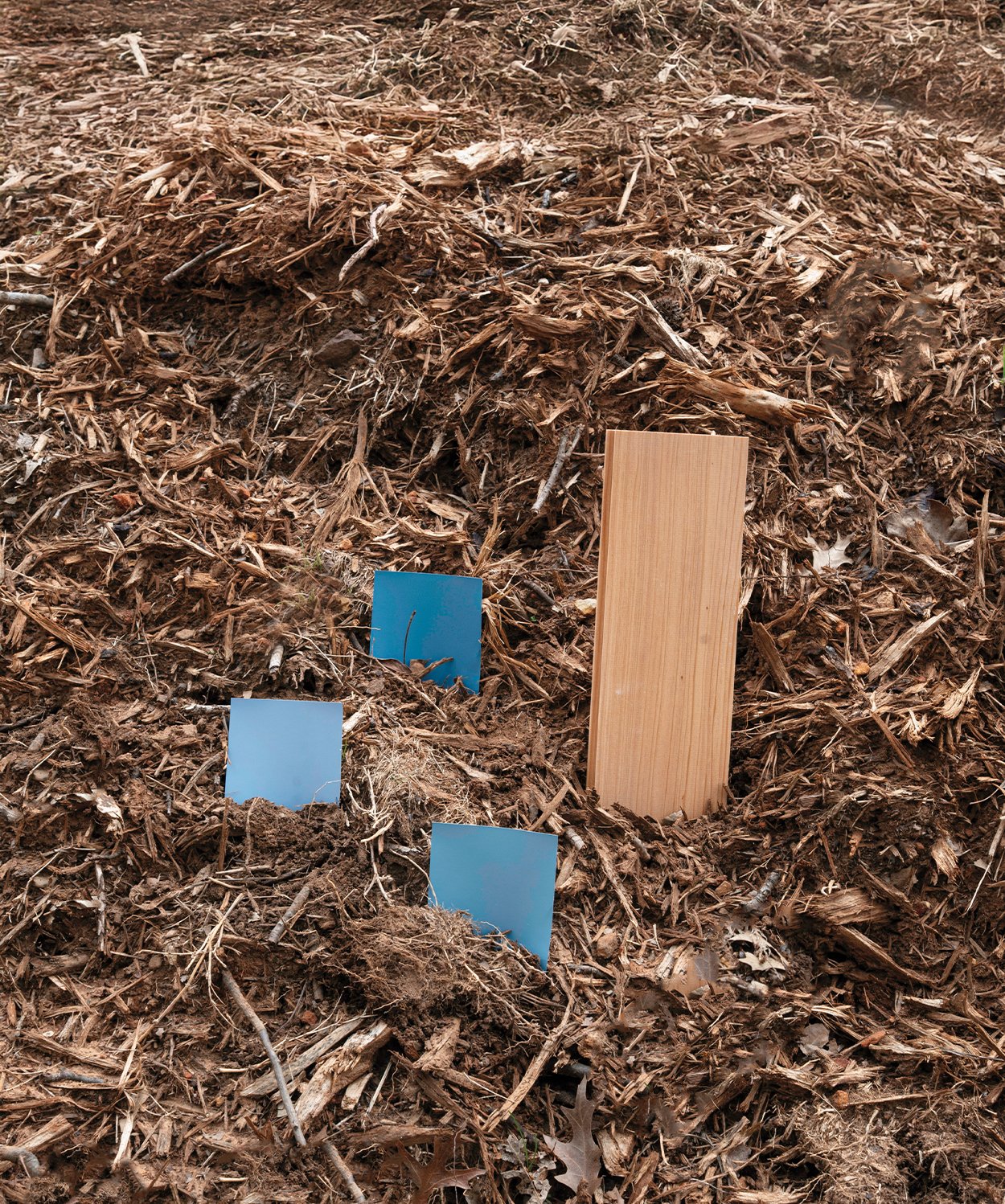
The underside is Haint Blue, which is a color from Geechee culture in Georgia. It started as a West African tradition: a blue that would keep away tortured spirits. It’s used in the South to actually keep spiders and insects away from your porch by painting the ceiling this blue, which is like the sky.
Avinash: You layer lots of sources in your work. You start from the vernacular, but you’re often trying to build ideas on top of it. That’s really unique to your practice.
Ati: We’re trying to transcend the local and also push the envelope in some way. Porches in the South typically have some sort of support, right? But remove the idea of any [visible] supporting structure, and you start looking at this as though it’s some sort of flying machine, but it has all the elements of a porch. There is no symmetry to it. There’s a certain balance and also a sense of agitation.
I see our work as something that’s a little bit on the edge.
Marlon: It’s a little bit strange. We are sort of committed to re-creating strangeness in a wonderful way that has a kind of sensual pragmatism to it.
Would you like to comment on this article? Send your thoughts to: [email protected]
Latest
Projects
Where Housing Meets Humanity
Three innovative housing projects that focus on care, community, and climate, redefining public housing with dignity.
Projects
Jeanne Gang on Harvard’s New Rubenstein Treehouse
The architect unpacks how material, structure, and openness converge in the university’s first mass timber building.